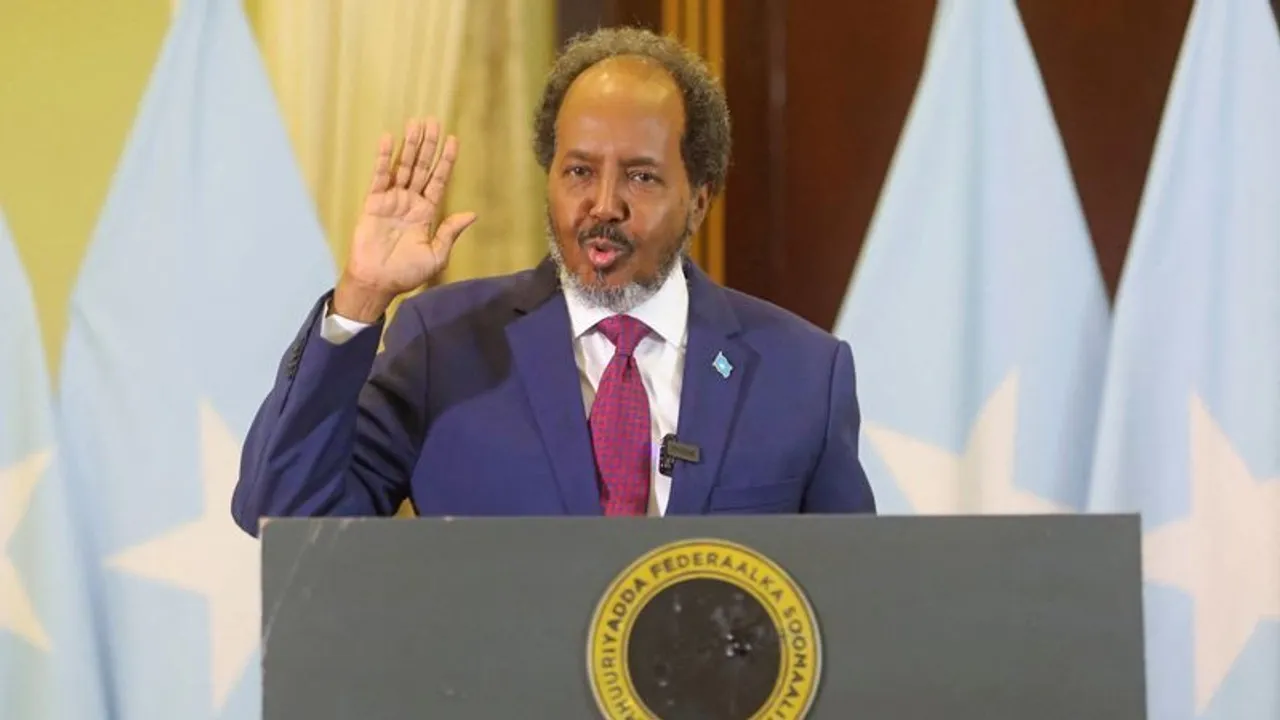
President Hassan Sheikh Mohamud has hailed the completion of Somalia’s constitutional overhaul as a decisive break from decades of political instability, framing the move as a “rebirth” of the nation that formally ends the era of transitional governance.
President Mohamud characterised the reforms as a national turning point, arguing that Somalia now possesses a “permanent constitution” to replace the provisional framework adopted in 2012.
“This is a historic day,” Mohamud said on Thursday, describing the milestone as the “official conclusion of the long, drawn-out transitional period”. He added: “We have brought that phase to an end”.
The president portrayed the shift as a victory over what he described as the “invisible restraints” of provisional rule. He argued that the prolonged transitional status had become a “legal shackle” that paralysed governance, fuelled federal power disputes, and undermined international investor confidence.
Remedy to 'political mistrust'
“Transition... became a major obstacle that prevented the country from achieving full stability – whether in politics, security, the economy, society, or international relations,” Mohamud said.
Somalia has struggled with fragmented governance since the 1991 collapse of the central state, operating under a series of transitional charters.
Mohamud insisted that previous delays in finalising the constitution were often driven by political self-interest rather than bureaucratic failure.
“The provisions that needed completion... touched power itself,” he said, pointing to long-unresolved disputes over federal power-sharing, natural resource governance, the judiciary, and electoral models. “Whenever the final decision approached, political calculations, mistrust, and delays... would emerge”.
Social contract




Positioning the new document as a social contract designed to restrain the political class, Mohamud sought to contrast the formal constitutional order with Somalia’s history of “elite bargains” conducted outside of legal frameworks.
“The constitution is a social contract that restrains the politician,” he said. “It sets limits they cannot cross”. He added a direct warning to opponents: “From today onward, we do not want an artificial agreement with no constitutional basis... deciding the fate of the nation.”
The reforms address core fiscal and resource-sharing tensions that have frequently pitted the federal government against member states. Mohamud argued that clarity on “public financial management, resource-sharing, tax harmonisation, and defining who administers natural resources” is essential to unlocking economic growth.
The overhaul had faced resistance from some political factions who argued it would centralise authority or upset the federal balance.
'Open process'
Mohamud allayed these fears, praising the 11th parliament for what he described as a transparent process involving “open debate” and “national consultation.”
“It was not voted on in a dark house... not voted on in a closed place,” he said, noting that sessions were broadcast live. He further insisted the reforms were not tailored for his own benefit, stating: “I have no guarantee that this constitution favours me... It was not written for me”.
Looking ahead, the president tied the constitutional shift to the promise of “one-person, one-vote” elections, suggesting that future political contests must be determined within these new legal channels.
“I can say with confidence: the hardship of transition has been overcome,” Mohamud declared. “Today a new sun has risen for us”.