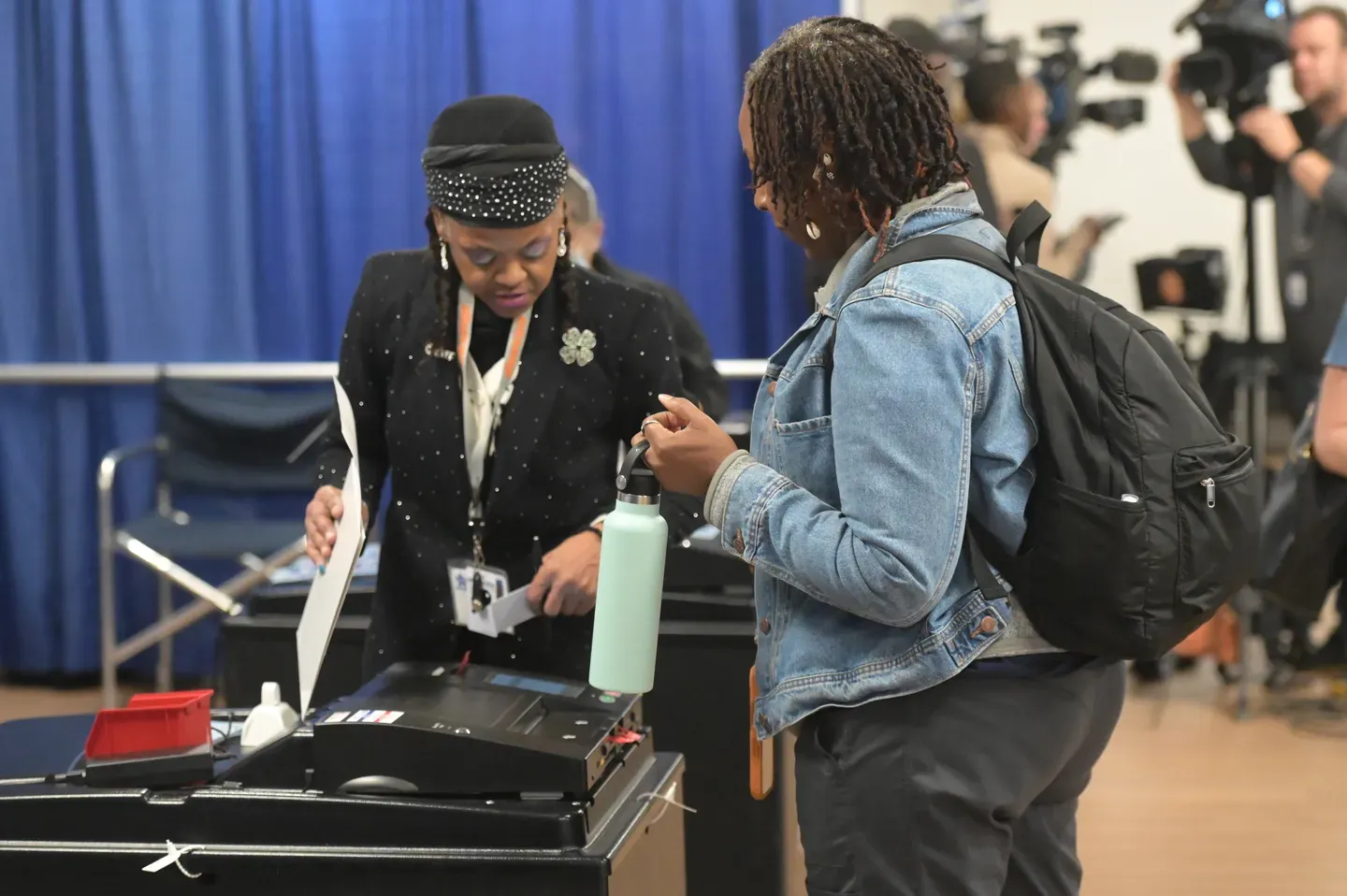
Polling stations have opened in several US states as Americans head to the polls in midterm elections to choose members of Congress, governors and other state and local officials, following record early participation.
Polling began at 1100 GMT in New York, Connecticut, New Jersey, Virginia and parts of Indiana and Kentucky on Tuesday.
Polling stations opened next at 1130 GMT in North Carolina, Ohio and West Virginia.
A broad wave of polling stations opened at 1200 GMT, including those in Delaware, the District of Columbia, Georgia, Maryland, Massachusetts, Pennsylvania, most of Rhode Island, South Carolina and eastern parts of Florida and Michigan, as well as those opening at 6 am Central Time in Illinois, Louisiana, Missouri and western parts of Indiana and Kentucky.
All 435 House seats and 35 Senate seats are being contested, along with governorships in 36 states. Voters will also elect state lawmakers and other local officials, while some states will hold referendums on policy issues.
Republicans currently control both chambers of Congress, while Democrats are seeking to gain control of at least one chamber and limit President Donald Trump’s ability to advance his legislative agenda.
Voting will continue throughout the day across multiple time zones, with the first regular poll closings scheduled for 2300 GMT.
Record early voting
The November 3 vote follows record early participation, with more than 58 million ballots already cast, exceeding the approximately 45.9 million recorded before election day in 2022, according to the University of Florida Election Lab.
Early voting includes ballots cast in person at designated polling stations and those returned by mail.
Texas has recorded more than 7.7 million early votes, up substantially from the 2022 midterms.
In Harris County, which includes Houston, participation surpassed 1 million before the early-voting period ended.
Other states have also recorded substantial early turnout. University of Florida figures show more than 5.4 million ballots cast in Florida, 2.8 million each in Georgia and North Carolina, and 1.8 million in Michigan, based on state reports available through Sunday.
The figures indicate increased participation ahead of election day but do not predict which party will benefit.
In states reporting voters' party registration, Democrats account for about 43 percent of early ballots, Republicans about 32 percent and independent or other voters roughly 25 percent, according to the University of Florida Election Lab.
Registration figures do not indicate actual votes, which are secret, and do not account for states that do not report voters' party affiliation.
Diverse electorate








Voters aged 65 and older represent about 44 percent of early participants in states reporting age data, compared with roughly 37 percent for those aged 41 to 65 and 6 percent for voters aged 18 to 25.
Approximately 249.75 million US citizens aged 18 and older are eligible to vote in the 2026 elections, according to estimates by the Pew Research Center.
The figure represents an increase of around 8.45 million eligible voters compared with the 2022 midterms, or approximately 3 percent.
The electorate is also becoming more diverse. White Americans account for around 61 percent of eligible voters, while Hispanic Americans represent approximately 16 percent, Black Americans 12 percent and Asian Americans 5 percent.
The Hispanic electorate has grown by approximately 5.25 million since 2022, reaching 38.95 million eligible voters. Asian Americans represent the fastest-growing racial or ethnic group of eligible voters, increasing by around 20 percent over the same period to 13.65 million.
Eligible voters are not necessarily registered voters or people who will participate in the elections. The distinction is important when comparing the estimated electorate with early voting figures.
To vote in federal elections, individuals must be US citizens, at least 18 years old by Election Day, and meet the registration requirements established by their state.
House members serve two-year terms and represent congressional districts allocated among states according to population. All 435 seats are contested every two years.
The Senate
The Senate has 100 members, with two senators representing each of the 50 states. Senators serve six-year terms, and approximately one-third of the chamber is elected every two years.
Of the 35 Senate seats being contested, 33 are regularly scheduled elections, while two are special elections to fill vacancies.
Beyond Congress, voters will elect governors in 36 states and thousands of state legislators. According to the National Conference of State Legislatures, 6,139 state legislative seats are also being contested in 46 states.
Voters in 39 states and the Northern Mariana Islands will additionally decide on 146 statewide ballot measures, covering issues including taxation, public spending and constitutional amendments.
Results will be reported as ballots are counted, although close races and differences in counting procedures may delay the final certification.
The newly elected members of Congress are scheduled to take office on January 3, 2027, when the 120th Congress convenes.
The midterms will determine the balance of power in the House and Senate during the final two years of Trump's current presidential term.
The next US presidential election is scheduled for November 2028.