 Sylvia Chebet
Three countries. More than 3,000 kilometres. Multiple modes of transport.
That was the journey of a Kenyan man from the Democratic Republic of Congo (DRC) to Kenya, where he died shortly after arriving at hospital. Tests later confirmed he had Ebola.
Now, health authorities are racing to reconstruct his movements and establish who he may have exposed along the way.
“We have a clear pathway of how this patient moved all the way from north-western DRC, a town called Buta, to Kisangani by road, more than 325 kilometres, then he took a flight from Kisangani to Beni, about 375 kilometres away,” said Dr Patrick Amoth, director-general of Kenya’s Ministry of Health.
“He then took a road trip from Beni to Kampala, close to 470 kilometres, and then he eventually took a flight from Entebbe to Nairobi, approximately 700 kilometres. So, when you total (the distance covered), this guy travelled more than 3,000 kilometers to reach Kenya.”
The challenge is to establish who he encountered, whether those interactions posed a risk of infection and whether further transmission may have occurred.
Following confirmation of the case, the World Health Organization (WHO) says contact tracing and epidemiological investigations began in all three countries.
Dr Dick Chamla, WHO Africa’s programme area manager for emergency preparedness, told TRT Afrika that investigators must identify people who travelled with the patient, assisted him or treated him, as well as others who may have been exposed.
“This is big challenge as there is still limited information on the number of contacts and places where those contacts are, or have gone,” Chamla said.
“Each of those contacts has a risk of contracting Ebola and potential of further transmitting it to others.”
How did he cross borders undetected?
The investigation has raised questions about how the patient travelled through multiple locations despite reportedly seeking treatment at several hospitals in the DRC.
“He was treated in Buta, he was treated in Kisangani, he was treated in Beni, he spent a whole night in Kampala,” Amoth said.
“Probably because of the challenges in DR Congo, maybe he was not comfortable with seeking services there, but had he sought services in Uganda, probably we would be speaking a different story. But that’s just a hypothesis.”
Kenyan officials believe he may have been trying to reach home to seek treatment or be with his family.
“This is a Kenyan and maybe he was coming back either to look for better treatment or he said: 'let me go and if I die, let me die next to my family',” Health Minister Adan Duale said.
At Jomo Kenyatta International Airport in Nairobi, the patient passed through routine temperature screening.
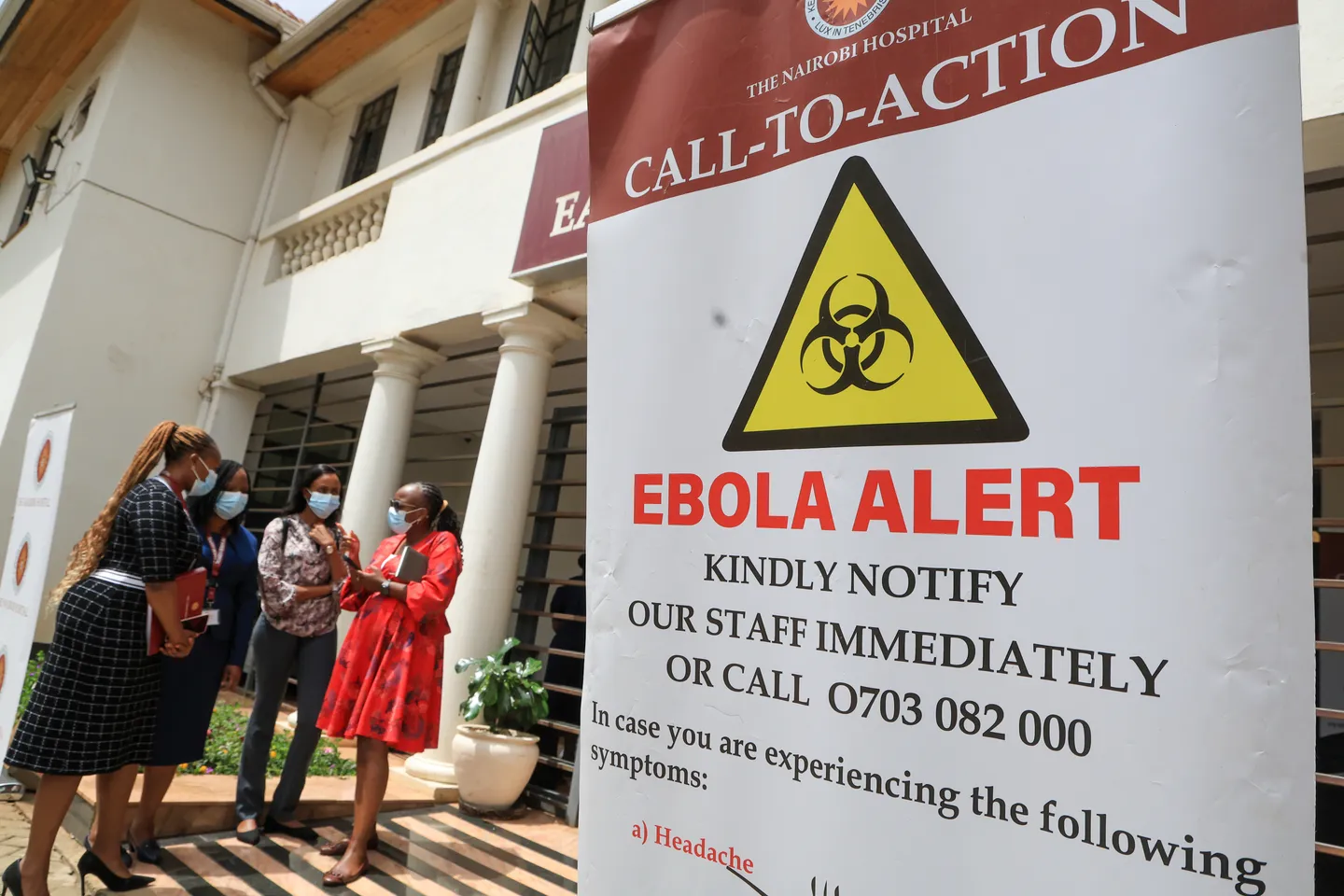
“He underwent the normal screening which is an automatic thermo scanner, so you simply walk through, it detects your temperature,” Amoth said.
“We postulate that this patient was on treatment or took some medication to be able to mask some of his symptoms to be able to lower his temperature and therefore was able to pass through. And we also think that is the reason he moved direct from the airport, called a relative to pick him to Nairobi Hospital.”
That remains a hypothesis. Officials have not conclusively established why he was not flagged at the airport. They also say he did not declare his illness or relevant travel history on the required health surveillance forms.
Kenya’s passenger screening system relies partly on travellers providing accurate information about their symptoms and recent movements.




“My appeal to people is to make the correct self-declaration,” Amoth said. “It is not a punitive measure, it is to protect your health. If you have any particular symptom that is listed in the surveillance form, if it is positive for you, check it out as positive, so that we can be able to identify you and offer you help.”
Could this become a super-spreading event?
A journey spanning thousands of kilometres raises concerns about whether an imported case could trigger further infections across communities and national borders.
But the journey alone does not mean a super-spreading event has occurred.
Ebola spreads through direct contact with the blood or other bodily fluids of an infected person who is showing symptoms, or through contaminated objects and materials. The risk depends on the nature of each encounter.
Not everyone who shared a bus, aircraft or public space with the patient was necessarily exposed.
However, his movements through multiple transport hubs and health facilities complicate the investigation. Epidemiologists must establish when his symptoms began, how his condition evolved and whether any contacts subsequently became ill.
Until that work is complete, the extent of potential exposure remains uncertain. The priority is to identify and monitor contacts, assess anyone who develops symptoms and arrange prompt isolation where necessary.
Why border screening is not enough
The case highlights the limitations of relying on temperature checks alone to detect infectious diseases. Fever is an important warning sign, but screening can miss people whose symptoms are not yet apparent or whose temperature does not trigger an alert.
“Fever is only one of the symptoms which constitute a case definition of the Ebola suspect,” Chamla said.
“The use of AI-enabled digital screening tools that link temperature measurements, travel history and symptoms, are also increasing.”
Such tools may strengthen detection, but they cannot replace surveillance in communities and health facilities.
Chamla said insecurity in parts of the DRC also complicates Ebola containment by restricting access to affected areas. Low community trust, limited contact tracing and attacks on health infrastructure can further hamper efforts to interrupt transmission.
The case underscores the need for neighbouring countries to share information quickly and coordinate their response when infections cross borders.
The regional lesson
The patient’s journey illustrates how easily an infectious disease can move across a region through ordinary travel, and how difficult it can be to reconstruct that journey after a case is identified.
No single screening measure can guarantee that every infected traveller will be detected at a border. Effective surveillance requires timely information-sharing, stronger links between health facilities and public health authorities, and coordinated contact tracing.
For Kenya, Uganda, and the DRC, the immediate priority is to establish the extent of potential exposure and prevent further infections.
The longer-term question is whether regional surveillance systems can identify the next case sooner — before an infected traveller crosses multiple borders and the trail of potentially exposed people becomes harder to follow.