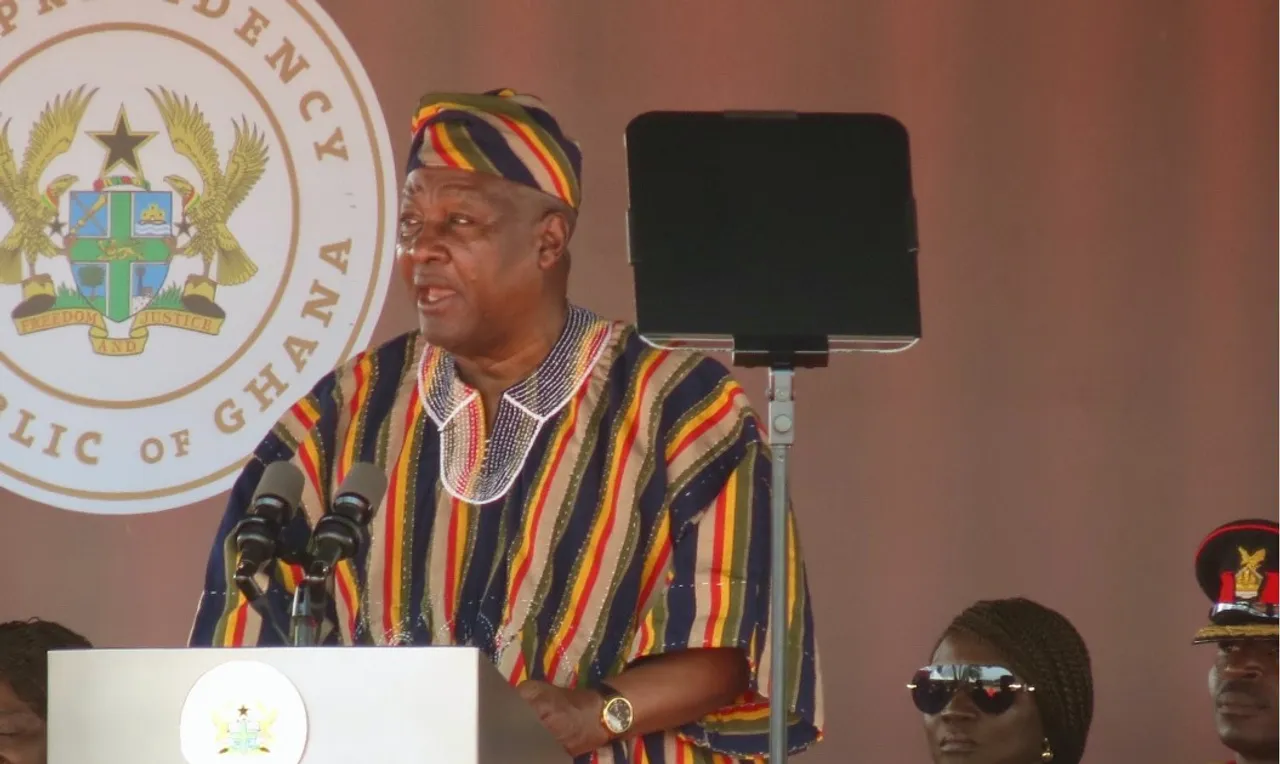
Ghana marked its 69th Independence Day with a scaled-down national celebration, with President John Dramani Mahama describing the move as necessary to demonstrate fiscal discipline during the country’s ongoing economic crisis.
The annual events, which take place on March 6 and are normally held with large military parades at Black Star Square, were instead staged at the forecourt of Jubilee House in the capital Accra, with a smaller ceremony attended by government officials, dignitaries, and cultural performers.
In his speech, President John Dramani Mahama paid tribute to the country's founding father and African independence hero, Kwame Nkrumah.
‘‘Today, we honour the memory of Osagyefo Dr. Kwame Nkrumah and all others who have led this country after him. All of them have been a part of our history and have brought us to this moment in our lives,'' Mahama said.
''Nkrumah did not only grant us independence; he awakened within us a sense of consciousness and a continental purpose,’’ he added.
The Ghanaian president vowed to push ahead with transformation in the country across various sectors and work together with other leaders across Africa for the continent's development.
‘Important milestone’
He said the government opted for a modest commemoration to reduce public spending at a time when Ghanaians are facing economic hardship. A full-scale celebration at Independence Square had been estimated to cost at least 20 million Ghana cedis ($1.3 million).
“In a year when we are calling on everyone to sacrifice … it would be unconscionable to spend that kind of money on a few hours of celebration,” the president said, adding that the scaled-down event would save about 95% of the projected cost.
“The state spent GHS 15 million on last year’s celebration in Koforidua and GHS 13.7 million on the previous year’s celebration in Ho. We received estimates of at least GHS 20 million for holding the event at Independence Square this year on the same scale as previous years,” Mahama said in his national address.
Despite the reduced scale, Mahama said the anniversary remains the most important milestone in the country’s history, marking Ghana’s independence from the United Kingdom in 1957 and inspiring other African nations to pursue self-rule.
Ghana was the first country in sub-Saharan Africa to gain independence from colonial rule under nationalist leader Kwame Nkrumah, whose Pan-African vision linked the country’s freedom to the broader liberation of the African continent.
In his address, Mahama urged citizens to use the anniversary as a moment of reflection on Ghana’s democratic progress and economic challenges. He called for greater self-reliance and national unity as the country works to recover from a severe economic downturn marked by high debt and fiscal pressure.
“Every anniversary of our Independence must present an opportunity for us to account for the legacy we are building for the next generation,” Mahama said, stressing that leaders and citizens alike must manage the nation’s resources responsibly for the future.
The Independence Day celebrations also featured schoolchildren in a march-past parade, security forces and cultural groups performing dances and other displays.