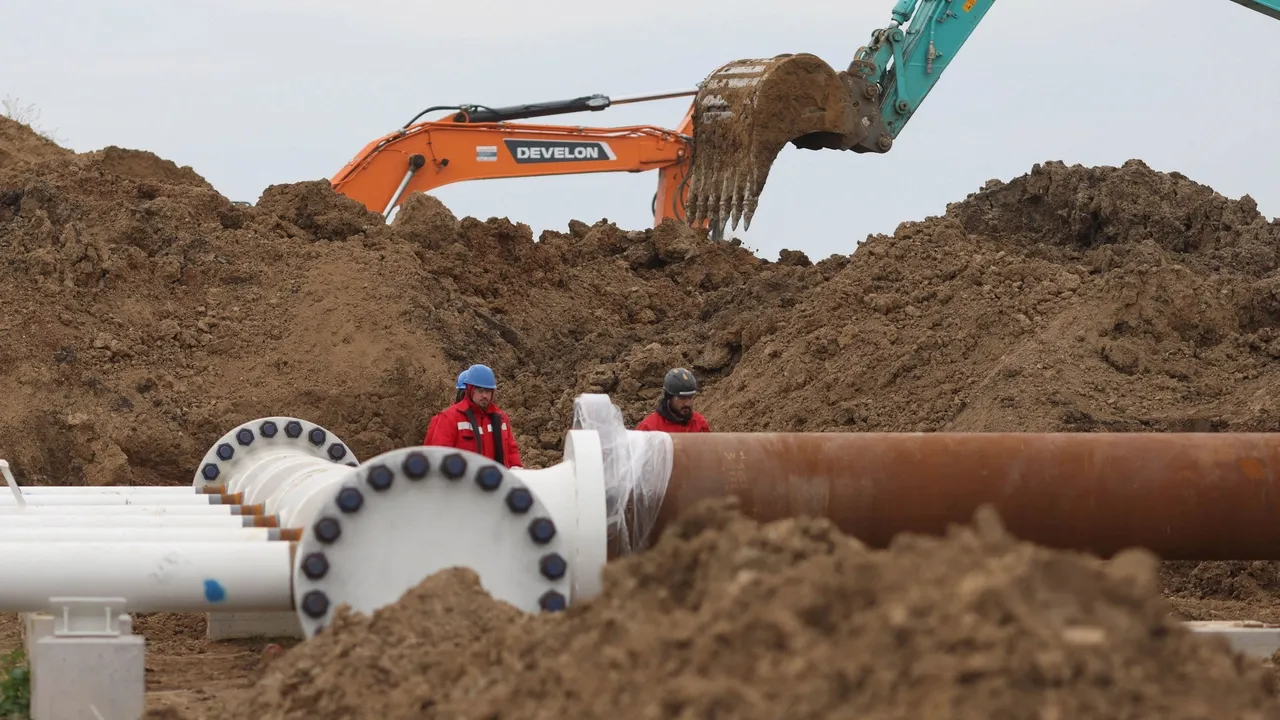
Algeria on Thursday launched construction of a new section of the Trans-Saharan Gas Pipeline, a major energy project designed to transport natural gas from Nigeria to Europe through Niger and Algeria.
Algerian Energy and Mines Minister Mohamed Arkab and representatives of Nigeria and Niger inaugurated the first welding operations for the pipeline, which will have a diameter of 48 inches.
According to project documents, the new Algerian section will stretch 1,210 kilometres from the Niger border to Aoulef, where it will be connected to the gas transport network leading to the Hassi R'Mel field, Africa's largest natural gas field.
From there, gas will be transported to export terminals in Beni Saf on Algeria's western coast or El Kala in the east near the Tunisian border.
One of Africa's largest energy infrastructure projects
The Trans-Saharan Gas Pipeline is one of Africa's largest energy infrastructure projects, with a total length of 4,327 kilometres linking Nigeria's Warri city to Hassi R'Mel through Niger.
The pipeline extends 1,185 kilometres inside Nigeria and 720 kilometres inside Niger. The Algerian section spans 2,424 kilometres, of which 1,210 kilometers are being newly constructed, while the remaining distance consists of existing pipelines transporting gas from southern fields to pumping stations and northern cities.





Arkab said the project would enable the transport of more than 20 billion cubic metres of natural gas annually from Nigeria and Algeria to European markets.
He said the project reflects the vision of Algeria's President Abdelmadjid Tebboune to strengthen African cooperation and expand partnerships among countries of the Global South.
'Driver of economic and social development'
The minister described the pipeline as a “driver of economic and social development, a source of wealth and employment, and a tool for strengthening African energy integration” while supporting regional and international energy security.
Niger's Petroleum Minister Hamadou Tene, for his part, announced that Niger will officially begin the construction of the 720-kilometre section crossing its territory in early 2027.
He described the project as a “historic undertaking that would have a significant economic and social impact on communities along the pipeline route” in Niger.