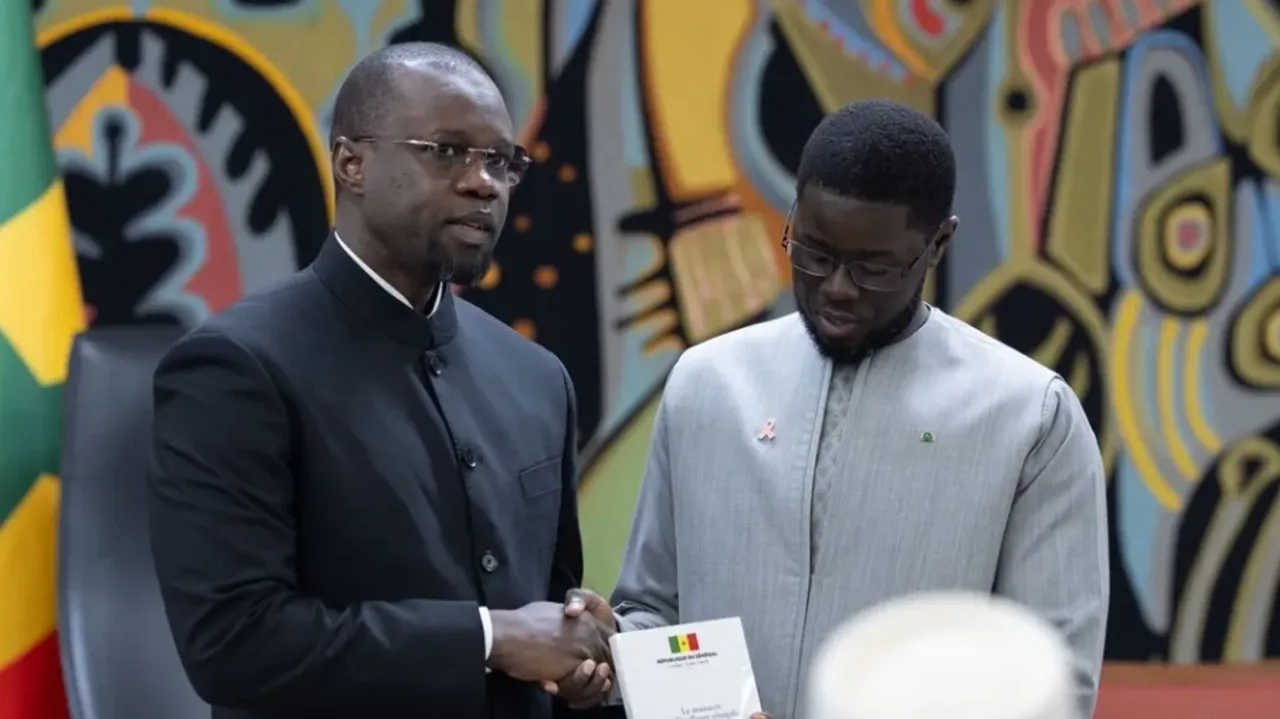
In Senegal, two close friends who rode to victory in a charged election in March 2024, have officially severed working ties.
Late on Friday, May 22, Senegal's President Bassirou Diomaye Faye sacked Prime Minister Ousmane Sonko, two years after the duo defeated Amadou Ba, Senegal's former prime minister, who had been backed by the then-President Macky Sall.
Former Prime Minister Sonko was barred from running in the 2024 presidential election due to a defamation conviction.
Sonko was popular among the Senegalese youth, and after the law barred him from the presidential race, he endorsed his longtime friend and deputy, Faye, for the top seat.
Act of reciprocity
Forty-six-year-old Faye won with slightly more than 54% of the vote.
Upon taking the oath of office in April 2024, he appointed 51-year-old Sonko as prime minister in what many viewed as an act of reciprocity.
In September 2024, President Faye dissolved Senegal's parliament, which, at the time, was dominated by members of former President Macky Sall's party.
Legislative elections were held in November that year, and Sonko's party, PASTEF, which had sponsored Faye's presidential candidature, won 130 out of 165 parliamentary seats, representing 78% of the legislative house.
Amendment of electoral code
That majority was recently used to amend the law that had previously barred Sonko from running in 2024 elections.
One-hundred-and-twenty-eight members of parliament voted in favour of the amendment of Articles 29 and 30 of Senegal's electoral code, which now impose temporary bans on persons previously removed from the voter's register due to convictions.
This essentially means that a temporarily-banned convict does not permanently lose their voting rights or the right to stand for election.




Eleven MPs voted against the then-proposed law in late April 2026, but 91% of lawmakers overwhelmed them, leading to the bill's passage.
Parliamentary speaker resigns
President Faye, thereafter, signed the bill into law in early May, paving the way for Sonko to potentially run for elections in 2029.
For now, Sonko cannot immediately return to parliament because he resigned as a legislator in December 2024, saying at the time that he would rather serve as the head of government through his prime ministerial position, and not serve parliament as the leader of the ruling party.
Interesting dynamics, however, played out on Sunday, May 24, 2026, when the Speaker of Senegal's Parliament, El Malick Ndiaye, resigned, potentially paving the way for Sonko to stand for election as the new parliamentary speaker.
Will Sonko take that chance? That is the question on many people's minds.
'Lighthearted'
Upon his sacking on May 22, Sonko said he would "sleep lighthearted", without revealing more.
But before his dismissal, there were apparent cracks in his relationship with President Faye.
On May 4, Faye had said that Sonko would keep his position if he "keeps doing his job properly", but the president warned he would sack Sonko if he poses a challenge to "Senegal's interests." Sonko recently faulted President Faye over Senegal's economic crisis.
For now, the relationship between the two leaders, whose friendship started many years ago when they were serving as tax inspectors in Senegal, has a hit snag. What will come next? Only time will tell.