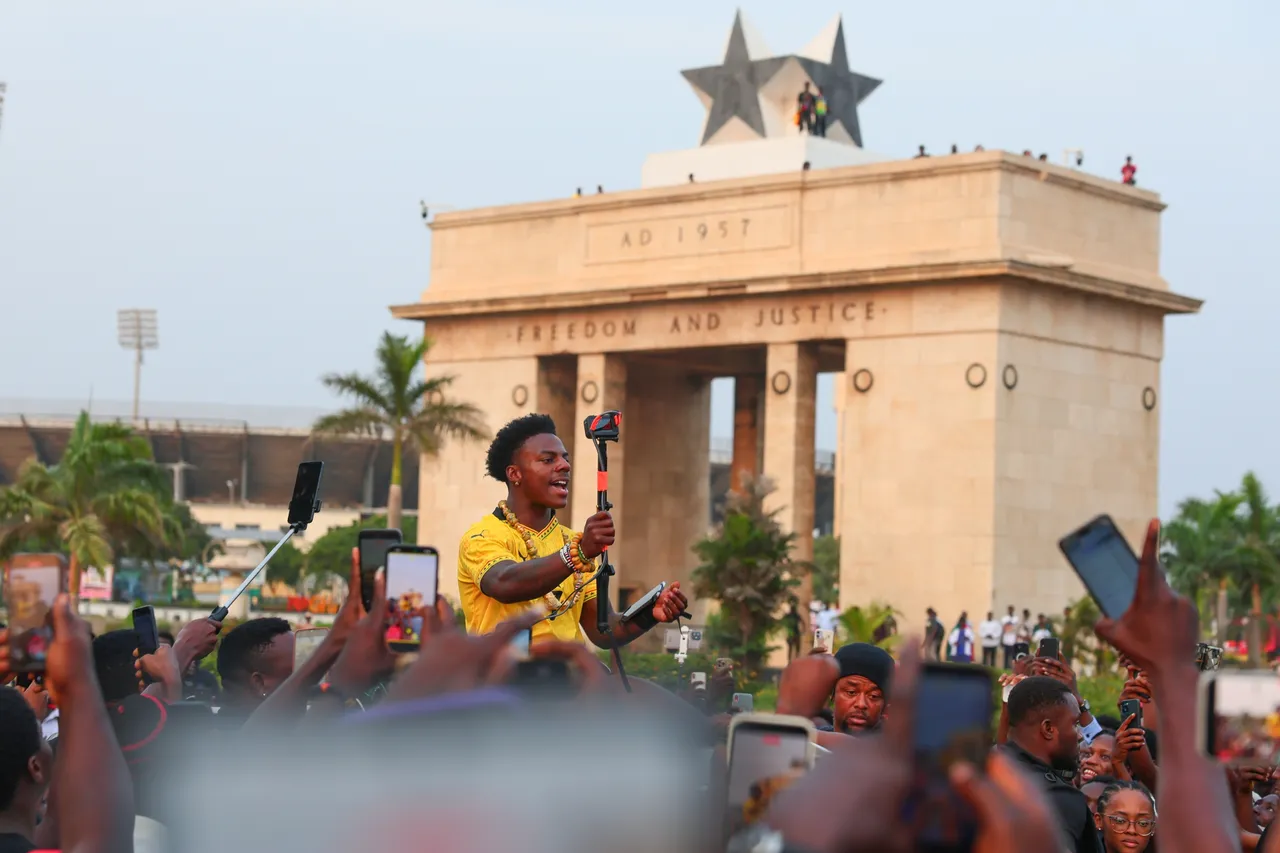
“I’m 100% African!”
This was the closing statement made by 21-year-old African-American social media sensation, I ShowSpeed (real name Darren Wright), at the end of an epic YouTube live stream tour in Africa, which was attended by hundreds of thousands of people.
He made an impressive feat- visiting 20 countries in 28 days, making history, by reaching 50 million YouTube subscribers on his 21st birthday while in Lagos, Nigeria.
During the tour, I ShowSpeed performed his famous back-flip on a pyramid in Egypt, contended with Maasai warriors in Kenya in a jumping competition, and became a chief in Ghana, gaining a new Akan name, Barima Kofi Akuffo.
To top it off, the West African country decided to grant him citizenship, though he said in one livestream episode that he was connected to Ghana through his mother.
He is the latest in a lineup of high-profile diasporic Africans who, in recent years, have visited various parts of Africa to reconnect with their ancestral roots, with some obtaining citizenship.
Reconnecting with ancestral roots
In January 2026, African-American actors Meagan Good and Jonathan Majors obtained citizenship from Guinea-Bissau, and singer Ciara gained the same in Benin following ancestry tests.
This comes off the back of Sierra Leone being the first African country to allow Africans in the diaspora to obtain citizenship through DNA testing and initiatives such as Ghana’s 2019 Year of Return, which marked 400 years since the first recorded enslaved Africans arrived in Virginia.
Ghana’s MyJoyOnline reported that the tourism industry recorded more than 1 million visitors that year, a 20% increase compared to "previous years. According to a BBC report published in January 2020, Minister of Tourism Barbara Oteng Gyasi said the Year of Return had injected about $1.9B into the economy.
Between the 15th and 19th centuries, nearly 13 million West and Central Africans were kidnapped, enslaved, and trafficked on slave ships across the Atlantic Ocean to the Americas and Europe in the brutal and horrifying Transatlantic slave trade, in which enslaved Africans were abused, exploited, and ripped from their families and loved ones, to work on plantations and as domestic slaves.

Gravest crime
On March 25, 2026, the UN adopted a resolution brought forward by Ghana’s President John Mahama that declared the Transatlantic slave trade as the “greatest crime against humanity in world history” and demanded reparations. On the 25th May 2026, the West African country scrapped visa fees for all continental Africans.
It’s within that context that many diasporan Black people from the Americas are looking to reconnect with West and Central Africa, what has been described as ‘roots tourism’. Long-term, some have been able to own land, set up businesses and charities, and build lives for their families.
But there’s been a growing trend of African Americans heading to East African countries like Kenya. Benin is another West African country that last year launched a digital platform offering a path to citizenship.
Candice Smith is an Afro-American and Ohio-native entrepreneur, beauty professional, and writer who can be found between Spain and Turkiye. She is the founder of Fearless Freedom Lifestyle, where she passionately advocates for travel, business opportunities, and reconnecting to Africa.




“We (the continent and diaspora) have been separated, not only by hundreds of years, but also by intentional propaganda and negative stereotypes that we have towards each other that keep us disconnected. I think especially for the diaspora, travelling to the continent, I would like to hope that frequent travel can help us to feel like we belong in the space. I think that, particularly for Afro-Americans, we're one of the few groups in the diaspora that still live in the land of our oppressors. We don't have our own sovereign nation-state.
And so to go to spaces where we can feel comfortable in our own skin is particularly important for our own ancestral healing and to release the strongholds of that cellular level trauma that we carry within us to various degrees”, she tells TRT Afrika.
‘Roots tourism’
Husband and wife, Krystal and Bennie Covington from the US, did this, moving to Namibia in 2024. Bennie tells TRT Afrika, “We felt we were being called by The Most High to return to our ancestral land. Krystal had a spiritual 'download” so to speak, where Namibia came to mind — she had never remembered hearing of the place — and we started researching to learn about it.
We had seen the movements that were happening on the continent and were intrigued, but we were timid about actually deciding to move because of the potential for big losses. What if we didn’t like it there? What if we got scammed? What if we couldn’t get jobs again? There was too much risk. If not for the spiritual pull, we would never have had the nerve.”
After considering South Africa, the couple and their children were drawn to what they describe as the mysterious meeting of the ocean and dunes and the communities they met.
They recently produced a documentary on their journey back to the continent, where they showcase the opportunities and challenges they’ve experienced, along with a Jamaican family.
Why we moved to Namibia | Official trailer (A Diaspora Journey Back to Africa)
“As with any move, there are as many cultural nuances to learn. It takes time to catch on to how basic things work. Language is spoken in English, but it’s not the same English. We had to learn new words and ways of talking to people,” she says.
“We ended up buying our home in an area that isn’t on a strong electric grid. So winter here gets extremely cold, and we can’t run heaters on the coldest days because the electricity goes out when too many neighbours do the same. We try to get by with heavy blankets and wool socks.”
In Ghana, for example, some natives have linked post–Year of Return migration to rising rents and land pressures, which comes as the country struggles with soaring inflation.
And in February, Ghana said it is suspending citizenship applications from descendants of Africans living abroad, which it introduced in 2019, to make the process "more accessible, efficient and user-friendly".
Place of power
At the same time, not all diasporans who obtain citizenship or stay long-term, with hopes of building a life on the continent, stay, with many returning to Europe or the US. This is due to several reasons, such as economic challenges like limited business opportunities, cultural misunderstandings and difficulties adapting to local and political systems.
“Some countries still haven't managed to get a streamlined process. And that's one of the reasons why there are issues with bribes and scams and things like that, and that need to be addressed because it's 2026. And I think it's time to clean up house, have a new way to do things. I know Benin has, from my contacts on the ground, Benin has really done an amazing job at making all of their services online, government services online”, Candice explains to TRT Afrika.
That said, Candice believes that there is still room for optimism, room for growth and continued connection.
“I think that once we finally shift and we really make that shift and that connection to each other where we're doing business with each other, where we're vacationing in each other’s countries, where we are creating these cultural bridges and connections and learning from each other, we will not only reach a place of peace, but we'll also reach a place of power. And I think ultimately, this is what all of our ancestors wanted for us.”