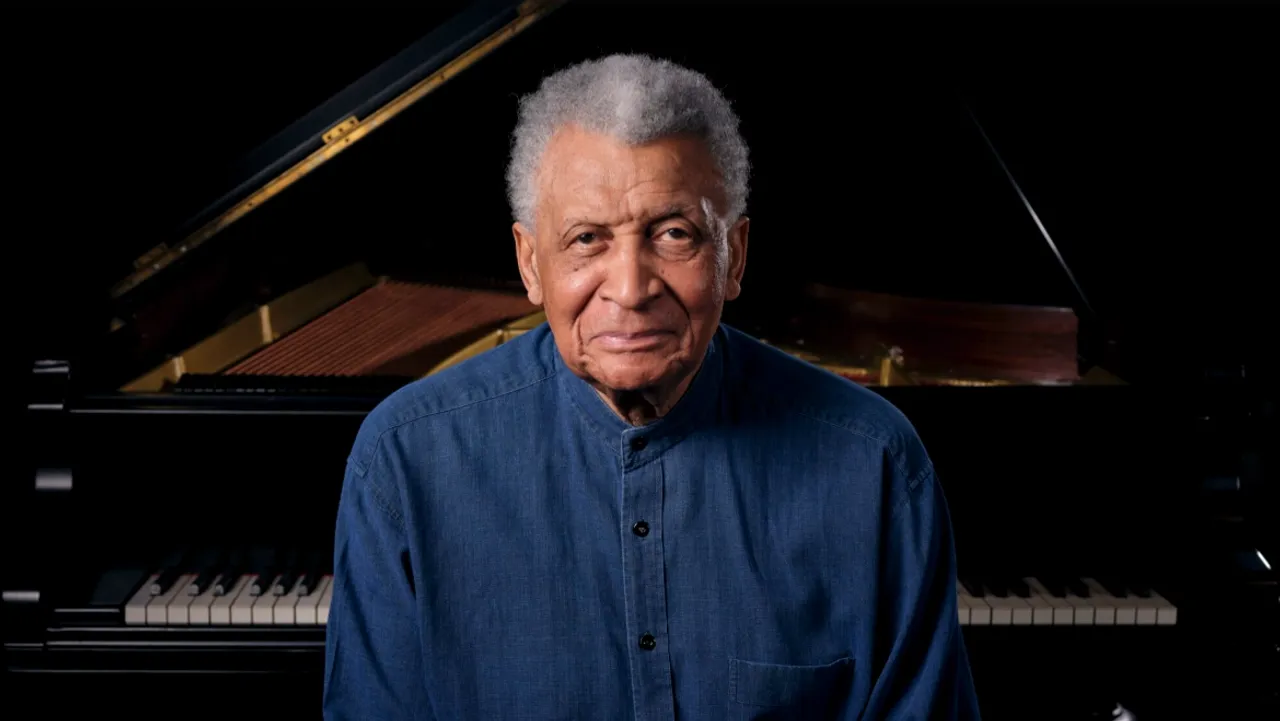
Pianist Abdullah Ibrahim, whose music buzzed with the bustle of South Africa's townships, resounded to the vastness of its savannah landscapes and was adopted as a rallying cry for the anti-apartheid movement, has died aged 91, the office of President Cyril Ramaphosa said on Monday. No cause of death was given.
Ibrahim layered American jazz and spirituals on top of the rhythms and melodies of Southern Africa to create a musical voice that challenged the brutality of his country's white supremacist government.
Born Adolph Johannes Brand in 1934, he grew up in Kensington, a tough Cape Town suburb. His father was murdered in a bar brawl when he was four years old. He was raised believing that his mother — who played piano in silent movie halls and in church — was his sister.
His grandmother, herself a church pianist who noted Brand's interest in her old upright, sent him to a school where he began to write songs shaped by Cape Town's port-city melting pot of African, European, Arab and Asian communities.
Dollar Brand
So enthralled was he with imported US records that friends nicknamed him "Dollar", according to the magazine Songlines. Embracing the name as a teenager, Adolph Brand became Dollar Brand.
He toured with dance bands and chafed at the restrictions imposed by the newly established apartheid system, especially for jazz musicians.
"You had to perform for your own ethnic group, and only musicians of your ethnic group were allowed onstage," he told the New York Times in 2019. "People started breaking this. It was part of this greater reaffirmation of our souls."
In 1958 he created the Dollar Brand Trio. The next year, the band expanded to become the Jazz Epistles, which included trumpet great Hugh Masekela. A self-titled record in 1960 is widely recognised as the first jazz album recorded by a Black South African ensemble.
Honed own sound
Faced with the closure of jazz clubs and the harassment of musicians by the authorities, several band members left South Africa. In their absence, Brand dedicated himself to honing his own sound.
In 1960, police fired on Black demonstrators in what came to be known as the Sharpeville massacre. Brand was reaching breaking point. A run-in with the police over a traffic incident proved the final straw. With vocalist Sathima Bea Benjamin, he settled in Zurich, Switzerland.
His big break came there, when Benjamin persuaded Duke Ellington to come to a show by the reassembled Dollar Brand Trio. The legendary US bandleader was so impressed he invited them to make a record. "Duke Ellington Presents the Dollar Brand Trio" was released in 1964.
A year later, Brand and Benjamin married and moved to New York. There he performed with the Duke Ellington Orchestra and played with giants of 1960s jazz, among them saxophonists Ornette Coleman, John Coltrane, Archie Shepp and Pharaoh Sanders, pianist Cecil Taylor and drummer Elvin Jones.
'Driving force'





In 1968, Brand — who by now was playing the flute as well as the piano — returned to Cape Town. There he stopped smoking and drinking alcohol, and found the spiritual answers that he craved in Islam, the religion of most of his childhood friends. "The most beautiful, potent aspect of Islam is the unity of things," he told the Guardian in 2001. "This realisation has been a driving force for me."
After changing his name to Abdullah Ibrahim, a flood of albums followed, including "Mannenberg — 'Is Where It's Happening'" in 1974. Named after a Cape Town township to which people were forcibly moved, its defiant title track became an anti-apartheid anthem with enduring power. It was played at Zohran Mamdani's inauguration as New York mayor in 2026.
"The thing that saved us was the music... It's not even what we called liberation music," Ibrahim said in "Amandla! A Revolution in Four-Part Harmony", a 2002 documentary film. "It was part of liberating ourselves."
In 1976, shortly after the Soweto student uprising, which was again met by police violence, Ibrahim staged an illegal benefit concert for the African National Congress, the then-banned political party of Nelson Mandela.
In the years that followed, back in New York, he made records with fellow jazz stars including bassist Cecil McBee, Buddy Tate and Don Cherry. He also wrote music for ballet, opera and film.
'Theorist of Black geography'
In 1990, with the apartheid system nearing collapse, Mandela was freed from prison. He invited Ibrahim to return to South Africa, where the pianist performed at Mandela's inauguration as president in 1994.
Asked whether Mandela had ever commented on his music, Ibrahim told US National Public Radio in 2013: "He came backstage and said, 'Bach and Beethoven, we've got better.'"
He released more records and toured on his own as well as with his band Ekaya. After moving to a village near Munich, Germany, he continued to perform in Europe and the US His last album, "3", was released in 2024, shortly before his 90th birthday.
Even as he spent much of his life abroad, the great rural expanses of his native land kept inspiring his music — and featuring on his album covers. A 2023 study in the South African journal Kronos called Ibrahim "a theorist of Black geography invested in the everyday sounds ringing through the ghettoes, townships and reserves."
Incredible technique
Ibrahim had a son, Tsakwe, a pianist in Cape Town, and a daughter, Tsidi, a New York-based rapper known as Jean Grae. His wife died in 2013.
Pete Letanka, a UK-based jazz pianist who worked with Ibrahim, said that his music, though traditional-sounding, was also deeply relevant to contemporary listeners.
"What makes it so beautiful is you're faced with the reality of all the obscenities of the apartheid regime but he is still capable of writing music that moves people to tears, whether it's 'Maraba Blues' or 'Water From an Ancient Well' or a call to arms like 'Mannenberg'," Letanka told Reuters in January this year.
"He never needed to dazzle us with incredible technique. There was something so spiritual, so awakened within him."