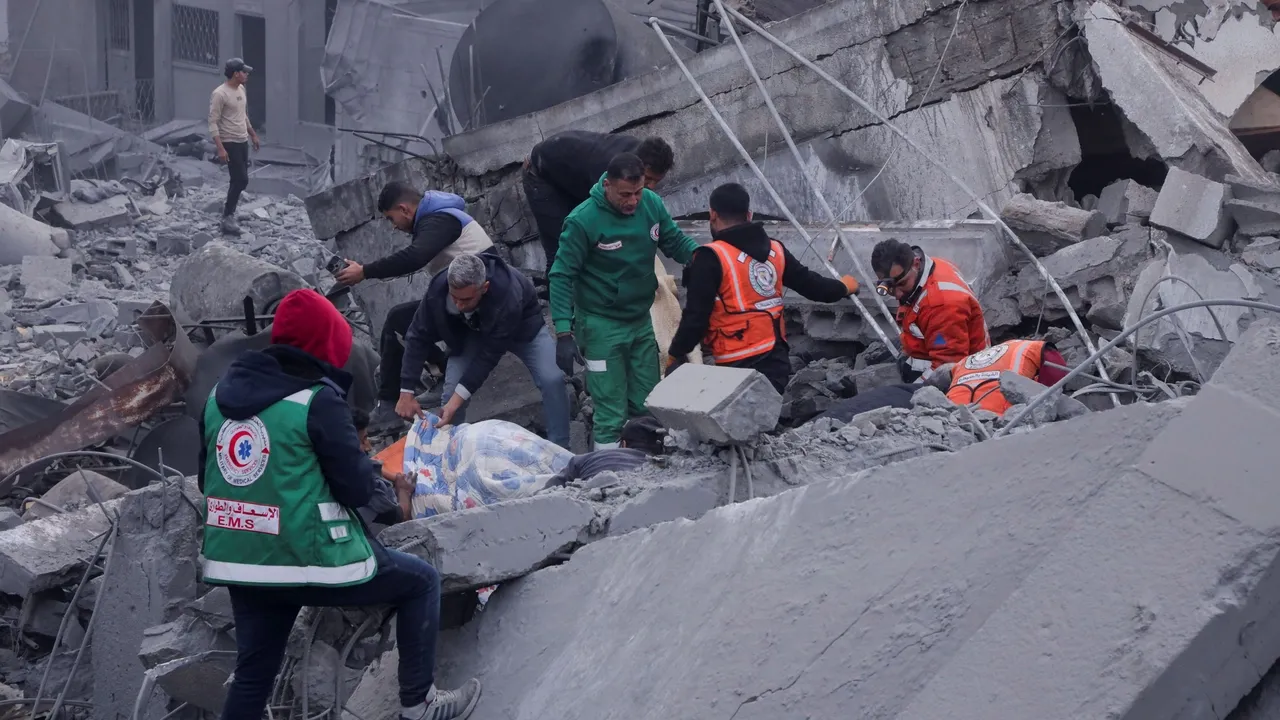
More than six months after a US-brokered ceasefire was meant to silence the guns, Gaza remains a vast unmapped cemetery.
According to Gaza's Civil Defence and a recent report by Haaretz, at least 8,000 Palestinians have remained trapped under the ruins of their own homes.
Despite the truce, the physical recovery of the enclave is virtually non-existent, with less than one percent of the 68 million metric tons of debris removed to date.
The scale of the devastation is difficult to overstate.
A joint assessment by the United Nations, the World Bank, and the European Union has estimated that clearing the rubble alone will cost upwards of $1.7 billion.
Alexander De Croo, head of the UN Development Programme, has asserted that at the current pace of work, it will take at least seven years to clear the enclave.
This logistical nightmare is further complicated by the pervasive presence of unexploded ordnance and the grim reality of thousands of decomposing human remains.
'Paperwork and stagnation'
For families across Gaza, the wait is more than just a bureaucratic delay.
Civil defence teams have continued to receive thousands of calls from relatives who know the exact coordinates of their loved ones' remains.
However, the lack of heavy machinery and specialised equipment has halted recovery efforts in some of the hardest-hit areas, including Gaza City's Shujaiyeh and Tuffah neighbourhoods.





In many cases, the remains are located beyond the so-called "Yellow Line"—areas still under the direct control of the Israeli military.
Families have been told by international organisations like the Red Cross and the UN that coordination for recovery must be approved by the Israeli side, a process that frequently leads to a dead end.
Ceasefire under strain
The slow recovery comes as the October 2025 ceasefire has been marred by daily Israeli violations.
Gaza's Health Ministry reports that Israel has killed 828 Palestinians since the truce began, adding to a staggering death toll of over 72,000 from the preceding two-year genocide.
This continued Israeli aggression has deterred rescue workers and international contractors from scaling up operations, as civil defence sites and ambulances remain vulnerable to attacks.
Even where recovery is possible, it is fraught with controversy.
In Rafah, local families have recently protested against certain contracting firms, accusing them of cooperating with Israeli authorities to clear sites for housing without the consent of the bereaved.
For many, the handling of these remains is not just a logistical task but a matter of fundamental human rights.
As one resident put it: "People have the right for their names to be known, to be buried, and to be mourned."