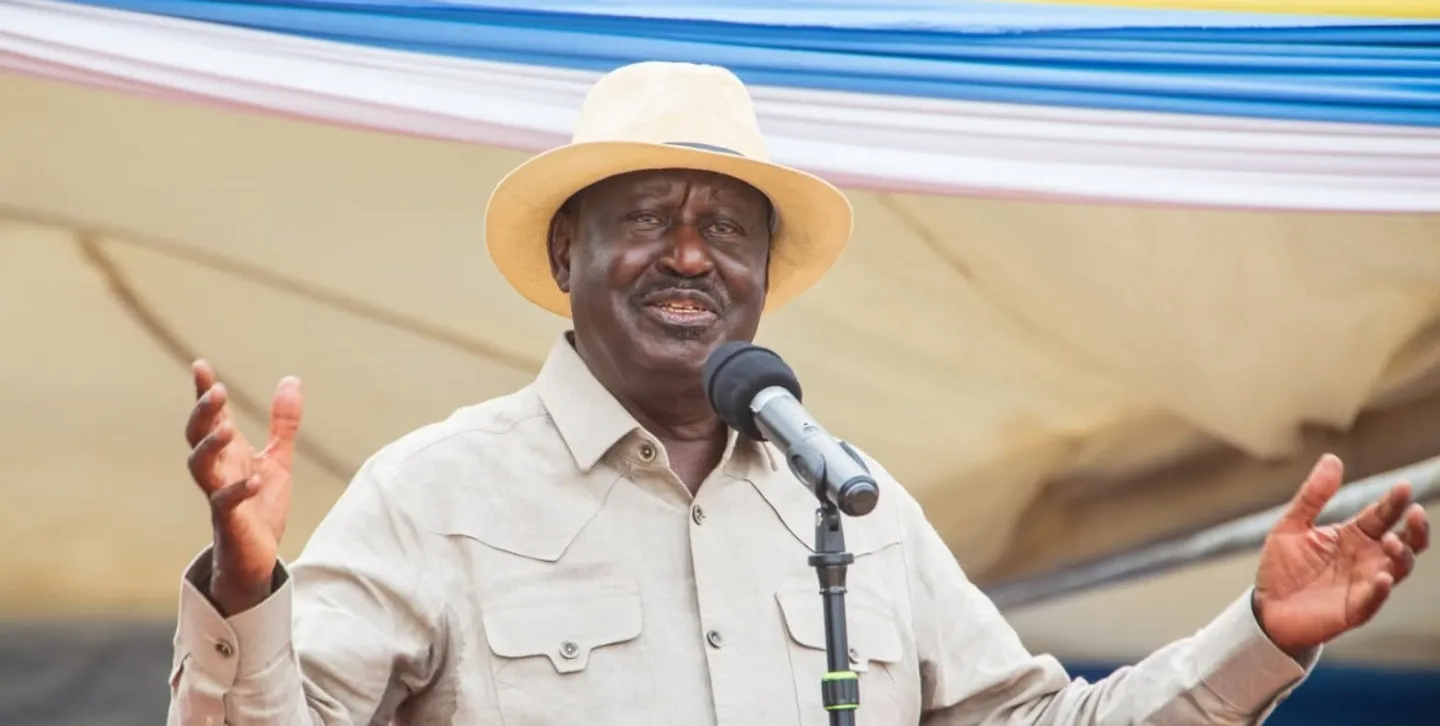
It is one year since Kenya's former Prime Minister Raila Odinga succumbed to an illness, and the East African nation feels the void caused by his absence. Odinga, the heartbeat of Kenya's opposition politics for more than four decades, commanded a huge following across the country of 55 million people.
His well-attended state funeral events in October 2025, beamed on televisions globally, highlighted the place the veteran politician held in his supporters' hearts. Thousands of people filled the streets to escort his coffin when his remains were repatriated to Kenya from India, where he died during medical treatment. Odinga's nickname "Baba", to mean "father" in Swahili, one of Kenya's two official languages, also highlighted the emotional connection he had built with the citizens.
The former prime minister was adored because of the spirited fight he put up in the 1990s and subsequent years to ensure Kenyans enjoyed several key freedoms, including the freedom to form multiple political parties and the existence of an organised opposition. He is also credited with championing the freedoms of expression and association, as well as reinforcing the right to fair trial in Kenyan courts.
Although he unsuccessfully ran for president five times in his lengthy political career, his once political rivals — Kenya's current President William Ruto and his predecessor Uhuru Kenyatta — publicly praised Odinga's enduring leadership attributes.
'Once-in-a-generation leader'
During Odinga's state funeral in mid-October 2025, President Ruto described him as "once-in-a-generation leader whose impact transcends his moment, whose courage inspires change, and whose vision shapes destinies." In an earlier statement, Ruto had eulogised Odinga as "the most significant leader of Kenya's democratic experiment."
Former President Kenyatta described the ex-prime minister as a "courageous" leader who had "the strength of mind and spirit, and love for his country."
The kind words from both Ruto and Kenyatta helped assuage the memories of the once fierce political battles Odinga fought against them between 2013 and 2022. The former prime minister lost to Kenyatta in 2013 and 2017 presidential elections and also lost to Ruto in 2022 polls. On those occasions, Odinga alleged electoral foul play, and his efforts to challenge their respective victories in court were unsuccessful.
Odinga would, shortly after losing to both Kenyatta and Ruto, find a way of working with the government of the day, in what was known in Kenya as the "handshake", to mean political rapprochement. Ruto described Odinga's consistent commitment to truce as "selfless", while Kenyatta said it cemented his credentials as a "peacemaker." Again, it is that same man who agreed to take the less powerful position of prime minister, when he controversially lost to Mwai Kibaki in Kenya's 2007 presidential election. Odinga said his decision, which some criticised as delayed, averted plunging Kenya into a full-blown civil war after more than 1,200 people died in the resultant post-election violence.
Glued Kenya's opposition together
One year after his death, Kenya sorely misses a leader whose unrivalled patriotism was praised by both Ruto and Kenyatta for always putting national interest above personal ambition.
His forgiving heart aside, Kenya also misses a politician who glued the country's opposition together and ensured the government of the day followed through on its election pledges.
Polycarp Otieno Nges, 32, a resident of Rangwe in Kenya's western county of Homa Bay, remembers Odinga's significant contribution toward the adoption of Kenya's 2010 constitution, which is in use currently.
"We enjoy the devolvement of state resources today, courtesy of Odinga's efforts in championing a new constitution. This has enabled rapid development in counties," Nges told TRT Afrika.

Frederick Otieno Omoro, a resident of Ndhiwa, also in Homa Bay County, described Odinga as a politician who effortlessly drew national support because of his notable contribution to Kenya's democracy and development.
"Odinga could pull large crowds in both his stronghold constituencies and in areas deemed to be politically hostile to him. I am yet to see a Kenyan politician with such level of charisma," Omoro recounted, with nostalgia readable on his face.
Since his demise, Kenya's largest opposition party that Odinga founded in 2005, Orange Democratic Movement (ODM), has split into two rival factions. One of the groups, led by Odinga's elder brother Oburu Oginga, supports a working arrangement with President Ruto, while the other, led by ODM's ousted Secretary-General Edwin Sifuna, opposes Ruto's re-election bid.
Oginga, an 82-year-old senator representing Western Kenya county of Siaya, says Odinga died when he had a working relationship with Ruto and the relationship should therefore be continued, while Sifuna, a 44-year-old senator representing Kenya's capital Nairobi, claims Ruto reneged on campaign promises and, as a result, does not deserve a second presidential term.
Widely admired
Oginga has retained his membership in ODM and serves as its leader, while Sifuna recently unveiled his new political party, The Equitable Party (TEP). Sifuna, a first-time lawmaker elected in 2022, says he is prepared to challenge Ruto in Kenya's 2027 presidential election.
But divisions within ODM are not the only cracks witnessed in Kenya's opposition, which was once solidly behind Odinga. Kenya's former Deputy President Rigathi Gachagua also unveiled his political party, the Democracy for the Citizens Party (DCP), in May 2025, after his impeachment in October 2024. There are a host of other opposition political parties that are also seeking to unseat Ruto in 2027, thereby making the opposition's unity efforts challenging to reconcile. Odinga, individually, managed to stitch Kenya's opposition together.
The undying love that his supporters had for him was witnessed on October 3, 2026, when Kenyans across the country lit candles in his memory.
Three hundred and sixty-five days after his death, the charismatic opposition leader's absence continues to form loud echoes within Kenyan boarders and beyond.
Immortalised
Odinga, the son of Kenya's former Vice-President Jaramogi Oginga Odinga, died at the age of 80 on October 15, 2025. Doctors said he succumbed to a cardiac arrest in India, where he was receiving treatment for multiple complications.
The Kenyan government has immortalised Odinga by renaming the $350-million Talanta Stadium in Nairobi, the country's newest and most expensive football stadium, after the ex-PM. President Ruto has also proposed that Kenya's third-largest airport, Kisumu International Airport located in Odinga's Western Kenya stronghold city of Kisumu, be renamed after the former prime minister.
Additionally, President Ruto posthumously awarded Odinga the highest national honour, the Chief of the Order of the Golden Heart of Kenya (CGH), a reserve of the sitting Kenyan president, alongside select foreign dignitaries and global leaders. Odinga's grave in Bondo, Siaya County, was also declared a mausoleum of national significance in October 2026.