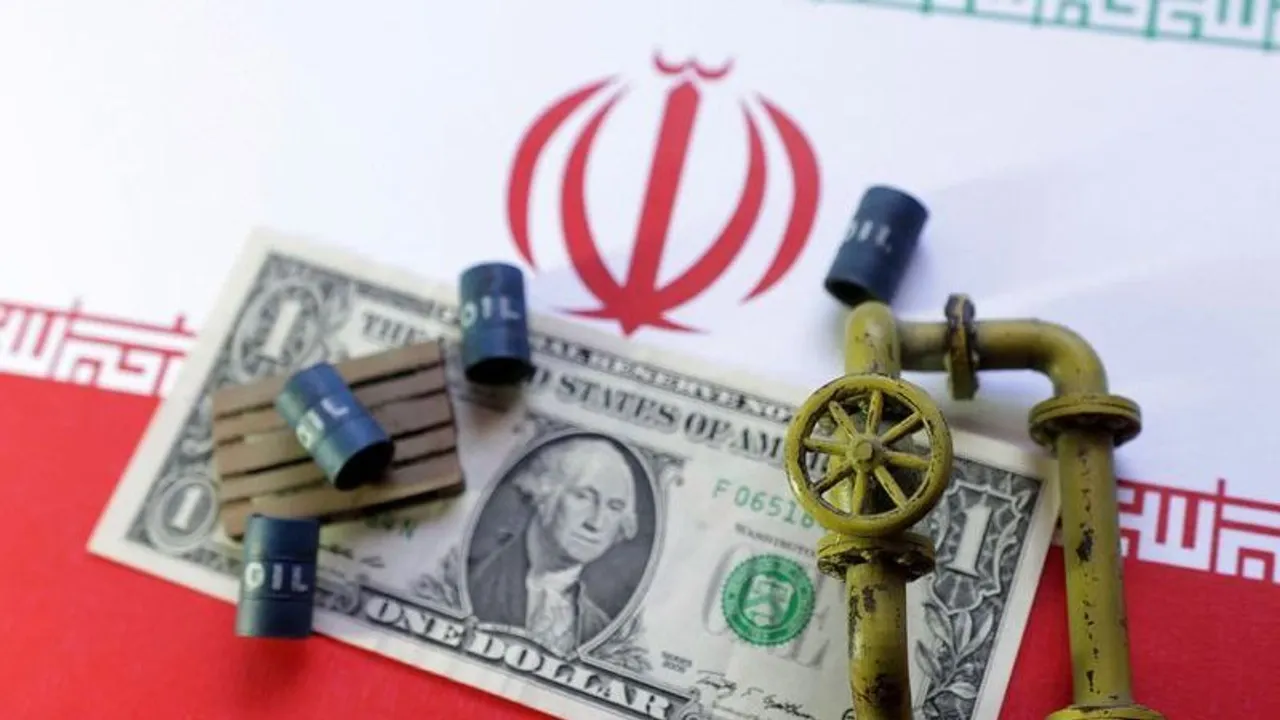
The US-Israeli strikes against Iran and retaliation by Tehran could severely disrupt the global supply of crude oil and send prices soaring to levels not seen in years.
Iran remains just inside the world's top 10 oil producers even though its output has fallen sharply since the 1970s, hit in particular by rounds of US sanctions.
The country produces about 3.1 million barrels per day, down from around double that output in the 1970s.
This remains a significant amount, and the Islamic republic is believed to hold the world's third-largest crude reserves, cementing its strategic importance.
Additionally, Iran's oil industry is in far better shape than that of Venezuela, another country hit by years of US sanctions.
Strait of Hormuz
The main risk to the oil market remains a blockade of the Strait of Hormuz, a vital waterway connecting the Middle East to the rest of the world for oil and gas shipments.
According to data from maritime analytics site Marine Tracker, traffic through the artery has plummeted and a slew of oil tankers have turned around or been stopped at the strait.
Local Iranian media reported late on Saturday that the country's Revolutionary Guards had warned "various ships" that the strait was currently unsafe to navigate due to US and Israeli attacks and therefore effectively closed.
Washington also warned ships about safety risks in the Gulf.
Insurance premiums
The impact on oil prices will remain unknown until Brent futures markets reopen for the coming week, but analysts have sounded warnings about such a scenario.
"$100+ oil per barrel soon," Kremlin economic adviser Kirill Dmitriev said on X.
Approximately 20 million barrels of crude oil passed through the narrow waterway daily in 2024, equivalent to nearly 20% of global liquid oil consumption, according to the US Energy Information Administration (EIA).
"Even a doubt about security in the Strait would prompt many vessels, for insurance reasons, to face difficulties transiting, as premiums would rise sharply," said Rasmussen.
According to Saxo Bank analyst Ole Hansen, "only Saudi Arabia and the United Arab Emirates possess meaningful bypass infrastructure."
Profitable crude



The route could transport a maximum of 2.6 million barrels daily, noted the EIA.
But US air and navy assets could re-establish shipping security if Washington chose to do so, said Jakob Larsen, safety chief at shipping association BIMCO.
Iranian crude is relatively easy and cheap to extract, with production costs as little as $10 per barrel, making it particularly profitable, Rasmussen said.
Only Saudi Arabia, Iraq, Kuwait and the UAE enjoy similarly low production costs.
Heavily reliant on oil
By comparison, major Western producers like Canada and the US typically face costs of $40 to $60 per barrel.
With such low costs, Iran gains disproportionately from high global prices, a crucial factor for an economy heavily reliant on oil revenues.
US sanctions imposed since the 1979 Islamic Revolution have left Iran with few export options – especially after President Donald Trump revived a "maximum pressure" policy on Tehran upon his return to office.
Iran exports between 1.3 and 1.5 million barrels daily, with more than 80% of the total bound for Chinese refineries owing to US sanctions, according to Ole Hansen, analyst at Saxo Bank.
Risk of escalation
Oil producing US allies Kuwait, the UAE and Iraq were all targeted by Iranian retaliatory strikes on Saturday, and multiple explosions were heard over Saudi Arabia.
"The risk of escalation is greater than seen in recent regional conflicts," said Jason Bordoff, founding director at Columbia University's Center on Global Energy Policy.
Iran's neighbours hosting US military bases "know they are vulnerable because the Iranians have enough basic intermediate-range missiles that allow them to strike vital points" in the worst-case scenario, noted Pierre Razoux, director of studies at the Mediterranean Foundation for Strategic Studies.
At-risk infrastructure includes hydrocarbon hubs as well as electrical power and seawater desalination plants, he added.
Global inflation
Soaring oil prices meanwhile risk a return to soaring inflation, hurting the global economy.
Crude reaching $100 per barrel for the first time since the start of the Russia-Ukraine war in February 2022 could also hurt Trump in the mid-term elections at the end of the year, especially as he has promised American voters cheap energy.