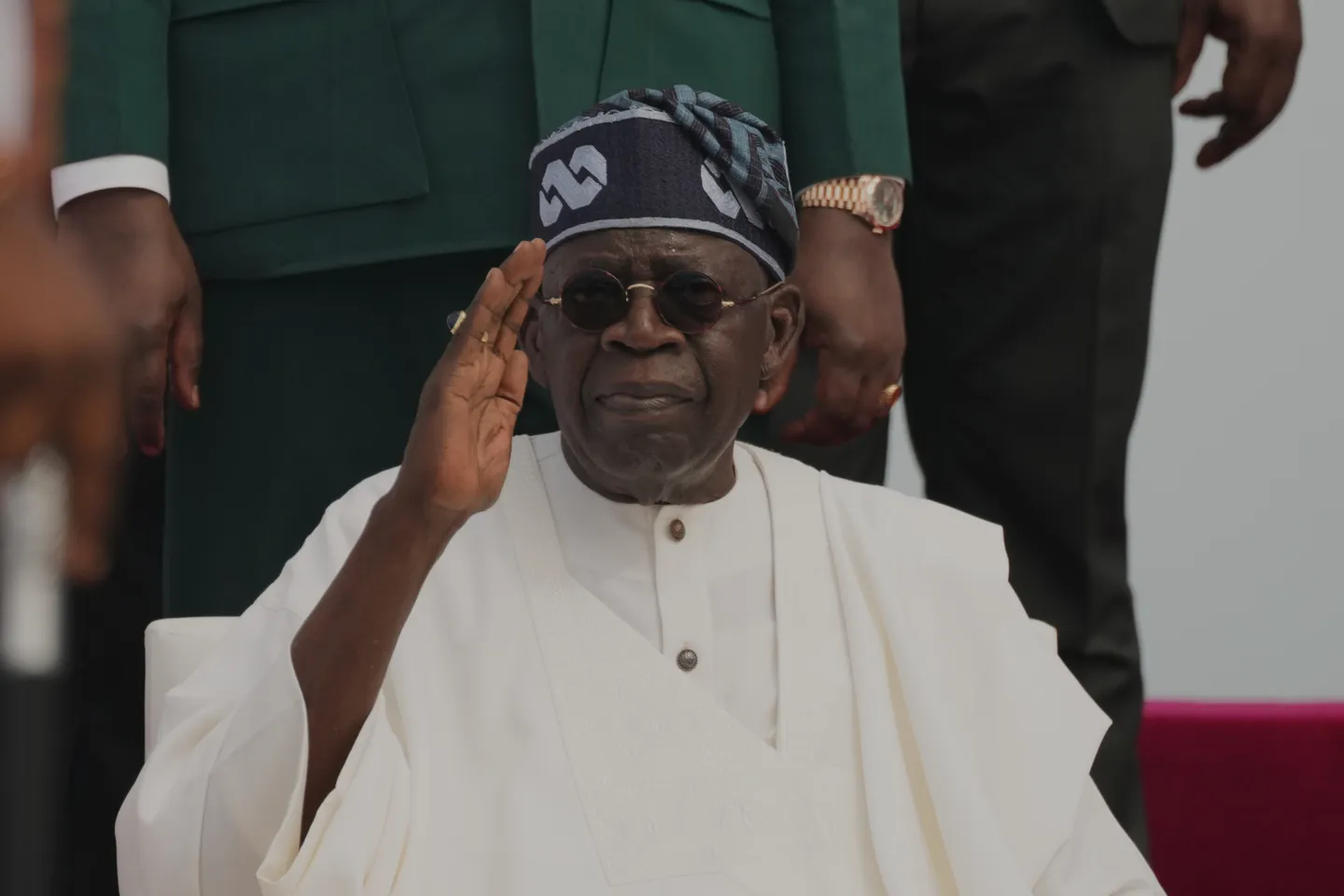
President Bola Tinubu is seeking re-election amid a complex economic outlook in Nigeria. His government and global financial institutions, such as the World Bank and the International Monetary Fund (IMF), state that the Nigerian economy has significantly improved under his leadership, while a large number of the citizens say the cost of living has become more unbearable during his rule.
Fuel price is apparently the most mentioned paint point for many Nigerians. When President Tinubu came to power in May 2023, he removed a longstanding petrol subsidy that had cushioned Nigerians against higher fuel costs.
The West African nation of around 240 million people is a major oil producer, but mostly exports it to generate government revenue. For its domestic consumption, Nigeria largely imports refined petroleum products. A mega oil refinery launched by billionaire Aliko Dangote in January 2024 aims to reverse this imports trend.
One litre of petrol in Nigeria's capital, Abuja, retails at around 1,400 Nigerian naira ($1), more than three times the amount it cost in 2023, when Tinubu assumed office. It is worth noting that the naira's value against major international currencies has been devalued during President Tinubu's rule, and this could translate into a higher amount when highlighting fuel prices presently. However, the citizens say that the money in their pockets has not proportionately increased, leaving them exposed to the vagaries of inflation. One US dollar retails at around 1,350 naira in the mainstream market currently, from around 460 naira in May 2023, representing an increase of more than 190%.
Pledges $1-trillion economy by 2030
But, according to the World Bank and the IMF, Tinubu's reforms have borne fruit at the macro level. The IMF projects that Nigeria's gross domestic product would continue to grow by above 4% in the coming months, resulting in an improvement of foreign reserves, investments, and revenue generation. The crisis lender, however, warns that these reforms, if not carefully balanced, could result in more Nigerians sliding into poverty. In October 2026, the World Bank named Nigeria as one of the African countries whose economies are "better managed", projecting its annual economic growth to rise from 4.3% in 2026 to 4.4% in 2027 through 2028.
Perhaps encouraged by these positive reviews, President Tinubu has pledged to improve the investment environment for the private sector in efforts to steer Nigeria towards a "one-trillion-dollar economy by 2030."
"Government alone cannot build a trillion-dollar economy. Wealth is created by enterprises that invest, innovate, manufacture, and export. Our duty is to clear the path before them. That is why we are harmonising our taxes, ending the menace of multiple taxation. We cannot tax our way into prosperity. We must produce our way there," the president said in a statement on November 12, 2026. According to the World Bank, Nigeria is currently a 290-billion-US-dollar economy.
While he is optimistic of staging a successful re-election campaign, citing his bold economic reforms, Tinubu's opponents, including Nigeria's former Vice-President Atiku Abubakar and former Anambra State Governor Peter Obi, claim that his administration's policies have led more people into poverty. According to the World Bank, the share of Nigerians living below the national poverty line has increased from around 56% in 2023 to 63% in 2026.
Trained accountant
Those figures notwithstanding, political analysts say that Tinubu remains the man to beat in Nigeria's January 16, 2027 presidential election. But who is Asiwaju Bola Ahmed Adekunle Tinubu, Nigeria's 16th president?
In another world outside politics, he would be a financial accountant. He has served in that capacity before.
Tinubu graduated with a Bachelor's Degree in Business Administration (Accounting and Management) from the Chicago State University in the United States in 1979. Although the authenticity of that undergraduate degree had come under public scrutiny, the Chicago State University confirmed to an American court on October 2, 2023 that the president was indeed its alumnus.
Shortly after graduating, Tinubu began his career as an auditor at Deloitte, one of the world's "Big Four" accounting firms. In 1983, Tinubu, in his early 30s, returned to Nigeria and was employed as an accountant by Mobil Nigeria, an international oil retailer.
'Workaholic and good dresser'
Raphael Jackson, a former employee of Mobil Nigeria, recounted his time working with Tinubu, describing him as a "workaholic" and good dresser, who loved "expensive silk shirts."
Tinubu, serving as Mobil Nigeria's treasurer, "remembered vividly how much had been allocated to each department, how much of it had been spent on what, and how much was remaining, throwing light on those departments that truly needed allocation amidst scarce foreign exchange," Jackson wrote in an article published on Nigeria's Western Post website on August 18, 2026.
Describing the head of state as deeply "human", Jackson recounted an evocative incident of the late 1980s. "A female employee who was trying to exit the elevator had her leg slipped into the side holes of the elevator and employees struggled to free her, BAT (Tinubu) played a significant role to help the female employee back to good health after her leg was amputated."
Jackson further describes Tinubu as "someone affable, with concern for accuracy", and who was "willing to help others, particularly the vulnerables."
Entry into politics
After spending eight years with Mobil Nigeria, during which he rose to the treasurer's position, Tinubu resigned in 1991 to pursue politics, successfully running for the Lagos West senatorial seat in 1992 elections under the Social Democratic Party ticket.
In 1993, Nigeria's then-military leader General Sani Abacha dissolved the Senate, and Tinubu joined the National Democratic Coalition movement to champion the return of democracy in Nigeria's politics. In 1994, Tinubu went into exile, spending most of his time in the United Kingdom. Upon General Abacha's death in June 1998, Tinubu returned to his home country.
Nigeria reinstated democratic rule in 1999, and Tinubu, a key member of the Alliance for Democracy, successfully ran for the seat of Lagos state governor in that year's election. Nigeria's presidency writes on its official website that the head of state "worked very hard with his team to remake Lagos into one of the most important financial, commercial, and cultural centres on the African Continent." Nigerians credit him with transforming Lagos into a model of urban governance after he implemented wide-ranging reforms, including in finance, infrastructure, transportation, and security.
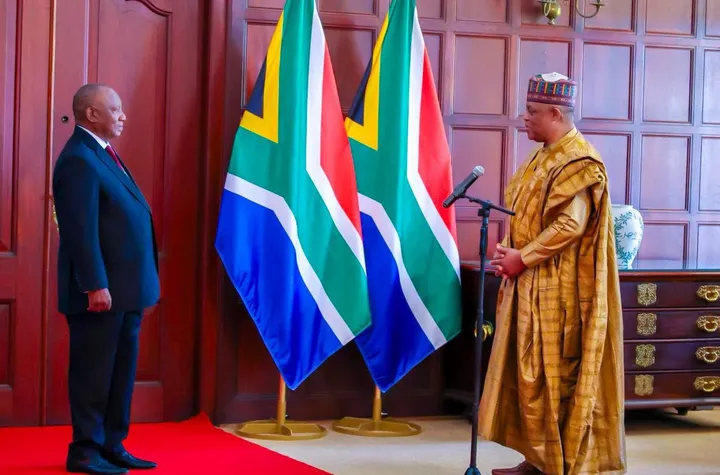



During his gubernatorial tenure, Tinubu often clashed with President Olusegun Obasanjo's administration over whether Lagos had the right to create new local council development areas (LCDAs) to meet the needs of the city's growing population.
Strife with Atiku
The friction with Obasanjo led to Tinubu persuading the then-Vice President Atiku Abubakar, a then-member of the Peoples Democratic Party (PDP), to lead the Action Congress of Nigeria, a party formed in 2006 by key figures within the Alliance for Democracy.
Atiku had fallen out with Obasanjo over political reasons, including Atiku's ambition to run for president. Tinubu had proposed to serve as Atiku's running-mate upon Atiku's acceptance to lead the Action Congress of Nigeria party (ACN), but the vice-president declined the then-governor's proposal, instead choosing the then-South East Senator Ben Obi to serve as his running mate.
Nonetheless, ACN supported Atiku's presidential bid, but he lost in the 2007 polls. Umaru Yar'Adua of the PDP won with nearly 70% of the vote, with Atiku coming a distant third with slightly over 7% of the vote, and behind second-placed Muhammadu Buhari's nearly 19%.
However, Tinubu's influence in Lagos politics prevailed. His successor, Babatunde Fashola, won Lagos gubernatorial election in 2007 on the newly-formed ACN party ticket. Following the opposition's bruising defeat in the 2007 general election, Tinubu and several allied politicians initiated talks to form a united party that could challenge the PDP in subsequent polls.
Support for Buhari
In February 2013, Tinubu's party the Action Congress of Nigeria (ACN), the Congress for Progressive Change (CPC), the All Nigeria Peoples Party (ANPP), a faction of the All Progressives Grand Alliance (APGA), and disgruntled members of the ruling PDP teamed up to form the All Progressives Congress (APC), a major opposition party.
In 2014, Tinubu supported Muhammadu Buhari, the leader of Congress for Progressive Change (CPC), to run for president under the newly-formed APC party. Buhari, who commanded strong support in northern Nigeria, had unsuccessfully run for president in 2003, 2007, and 2011.
Tinubu had initially expressed an interest to serve as Buhari's running-mate but later conceded to Yemi Osibanjo, his ally and ex-commissioner of justice.
Buhari would go ahead to win Nigeria's 2015 presidential election with nearly 54% of the vote, defeating the then-incumbent President Goodluck Jonathan of the PDP, marking the first time in Nigeria's history an opposition candidate defeated a sitting president. Jonathan got approximately 45% of the vote. Ahead of the 2019 general election, there were rumours that Tinubu was eyeing the presidential seat, but he put paid to the speculations after endorsing Buhari's re-election bid.
Successful presidential bid on first attempt
In the lead-up to Nigeria's 2023 elections, Tinubu announced his presidential bid in January 2022. In June that year, he won APC party's nomination to run for president, defeating the then-Vice President Yemi Osinbanjo to the ticket. He would proceed to win the presidential election with nearly 37% of the vote, ahead of Atiku Abubakar's 29% and Peter Obi's 25%.
Tinubu, a wealthy accountant-turned-politician, reportedly has business interests in the media, oil and gas, and logistics.
The 74-year-old head of state has six children; three with First Lady Oluremi Tinubu, and three from previous relationships. One of his sons, Kazeem Olajide Tinubu, died aged 37 in London, the United Kingdom, in October 2017.
President Tinubu, a Muslim of the Yoruba ethnic group, was born in Lagos, southwestern Nigeria, to a merchant family on March 29, 1952. He attended St. John's Primary School in Lagos before proceeding to Children Home School in Nigeria's southwestern state of Ibadan. He pursued university education in the United States.
Complex relationship with US
Tinubu, whose first four-year term in office ends soon, has a quite complex personal relationship with the United States. In August 2026, he formally asked a US federal court to prevent the release of records held by American authorities concerning historical investigations involving him.
His legal team filed a 16-page submission before the US District Court for the District of Columbia, arguing that the documents should remain withheld.
The president opposes a Freedom of Information Act lawsuit filed in 2023 by American transparency activist Aaron Greenspan, who is seeking records from the US Department of Justice, the FBI, among others.
The requested documents include the FBI's complete file on Tinubu, interview records from 1992 to 1993, and files relating to a 1993 US civil forfeiture case involving approximately $460,000 associated with him. Tinubu has denied any wrongdoing, with his lawyers arguing that releasing the records could violate his privacy rights.