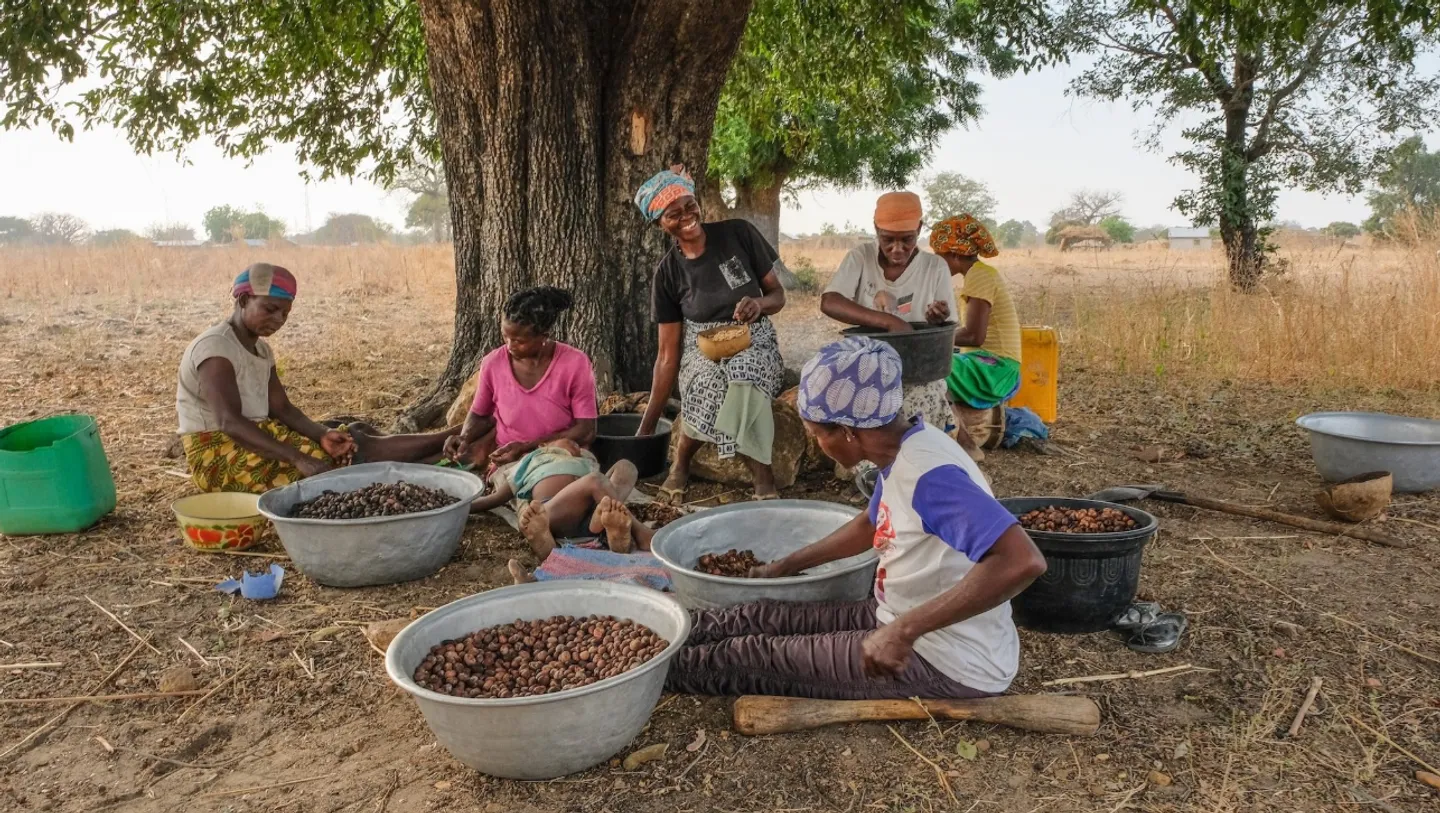
Joana Naab still dey remember di pain for her hand dem. For pass two decades, she dey crack shea nuts, boil kernels, and stir big pots of oil for small informal workshops for northern Ghana.
"Before, we for dey work from morning reach night, we go dey crack nuts and boil oil until our hand go dey pain," she talk. "Nobody dey ask if we don tire. Nobody dey reason wetin make dem go pay us."
Today, Naab na President of di Ghana Shea Workers Union (GSWU). Her journey from anonymous worker go become labour leader mirror di ogbonge changes wey dey happen for Ghana shea sector.
"Finally, from now on we fit work safely, get breaks and make correct pay… my hand go fit heal," she talk, her voice carry relief and strong mind.
Di change wey Joana dey talk no be just show. For March 2026, GSWU and di Ghana Shea Employers Association sign di sector first-ever Collective Bargaining Agreement (CBA), wey cover about 2,000 shea workers for 11 cooperatives and 160 processing centres. Di agreement set framework for fair wages, working hours, occupational safety, social protection, and grievance procedures.
Voices finally heard
For plenty workers for Ghana shea sector, to chop life don mean work for informal, seasonal, and spread-out industry, wey no get organised representation and wey get small chance to talk together about wetin dem dey face for work.
Only two years ago, thousands of workers for Ghana shea sector almost no get representation and little chance to influence the conditions wey dem dey work. Today, dem don build representative organisations, start social dialogue, and negotiate one important Collective Bargaining Agreement (CBA)—and dat don open new chances for decent work for an industry wey mainly dey driven by women.
But Joana sabi say paper promise no mean anything if dem no enforce am.
"For too long, labour agreements for agriculture sector, especially inside informal economy, don dey face wahala to implement," she talk. "By building joint reporting system with our employers, we dey put engine and wheels inside our collective bargaining agreement."
She add say fair wages, maternity protection, and workplace safety suppose become "non-negotiable."
Shea, wey na wetin dem dey take make shea butter, na natural fat wey dem take from kernels of shea tree (Vitellaria paradoxa), wey dey come from African continent. E valuable and people dey use am for cooking, making cosmetics, food, pharmaceuticals, and most importantly, as substitute for cocoa butter for chocolate production—industry wey mainly dey powered by women.
The economics of invisibility
For Bekwai, wey dey Ashanti Region, Rabiatu Abubakari dey inspect her warehouse with mix of frustration and determination. As President of di Ghana Shea Butter Employers Association, she don spend years dey push for better way to share di shea wealth for Ghana.
"We dey lose millions of cedis because our shea nuts dey export raw instead of processing am here for Ghana," Rabiatu talk. She estimate say about 70% of Ghana shea nuts dey leave di country unprocessed, and dat dey deny local communities jobs, revenue, and industrial growth.
Di obstacles wey local processors dey face na heavy gbege.
"When we go banks for loans, most times dem go reject us, and even when loan dey, di interest rates too high to sustain di business," Abubakari explain.





Di seasonal nature of shea harvest make matter worse: if dem no get proper storage, processors no fit run operations steady for whole year.
Abubakari talk say raw exports dey make women—wey be backbone of di sector—stay for bottom of di value chain. She calculate say Ghana dey lose as much as 300% of di potential value wey local processing for fit add.
Africa’s shea business
Di matter no end for Ghana only. For whole Africa, shea trade dey support about 16 million women across 21 countries, and majority of dem na collectors and small-scale processors. West Africa supply about 96% of global shea kernel demand, but di region only collect small part of final product value.
Ghana shea exports make pass $350 million for 2025, according to Ghana Export Promotion Authority—more than double di $118 million recorded for 2023. Di country rank as world leading exporter of shea butter in 2025. West Africa shea butter market value reach $1.25 billion in 2025 and dem project say e go reach $3.78 billion by 2031, with compound annual growth rate of 6.57%.
But dis growth fragile. Global Shea Alliance warn say West Africa dey lose about eight million shea trees every year because of population growth, agricultural expansion, bushfires, and climate change. If nothing do, dem project global demand for shea fit pass supply by 2044.
Shea solutions
Aaron Adu, Managing Director of Global Shea Alliance, dey see both danger and opportunity for di current situation.
"Across Africa, we dey lose around eight million shea trees every year," he talk. "This no be only environmental wahala. Na threat to biodiversity, rural livelihoods and industry wey support millions of women for Africa."
Adu organisation don launch Action for Shea Parklands initiative wey aim to plant and nurture 10 million shea and native trees, restore four million hectares of shea parklands, and empower 10 million women by 2030. Global Shea Alliance, wey represent 849 members from 36 countries, dey work to connect women's cooperative groups with brands, retailers, and suppliers wey dey demand traceable, certified sourcing.
For policy side, Ghana government don announce plan for phased ban on raw shea nut exports, targeted for 2026 but e never enforce yet. Di Buipé shea processing facility, wey dem bin abandon before, dem dey rehabilitate am with capacity to process 60 tonnes every year and e fit create hundreds of direct jobs.
For Adu, di breakthrough dey for balance between regulation and support.
"Ghana approach na to combine export restriction with complementary measures, minimum prices to protect women collectors, and certification systems to strengthen traceability," he say.
Di main goal na to move Ghana "from being a raw material exporter to a nation of value-added exports."
Di journey never still finish. But for workers like Joana Naab, something important don already change.
"We no be invisible again," she talk. "We get voice, and we go use am."