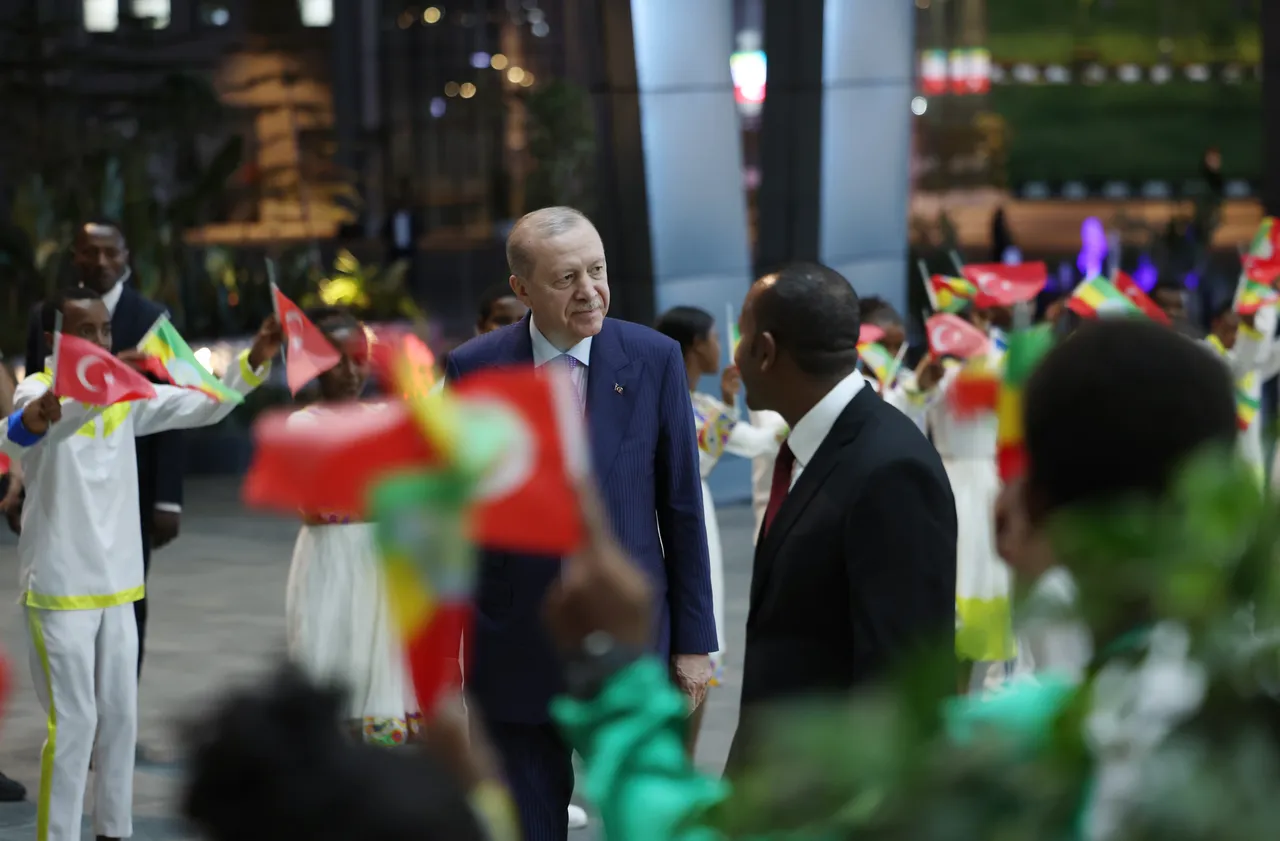
Turkish President Recep Tayyip Erdogan’s official visit to Ethiopia’s capital, Addis Ababa, marks more than a century of diplomatic ties.
It occurs at a time when the Horn of Africa is at the intersection of maritime access disputes, great-power competition and a shifting global order.
In the presence of Ethiopian Prime Minister Abiy Ahmed, new agreements were signed in trade, aviation, technology and development cooperation.
Yet beyond the formalities, analysts from Türkiye and Ethiopia describe the visit as carrying broader regional and even global implications.
At a joint press conference, President Erdogan underscored Ankara’s priorities.
“We do not want new conflicts to be added to the already heavy toll of pain and instability in this region,” the president said.
“We believe that the Horn of Africa should not be turned into a battleground for foreign powers.”
He also emphasised that Israel’s recognition of Somaliland would not benefit the wider region — a statement reflecting Ankara’s long-standing support for Somalia’s territorial integrity.
International relations professor Suay Nilhan Acikalin from Haci Bayram Veli University in Ankara tells TRT World that the centenary of formal ties — dating back to 1926, when Türkiye established its first diplomatic mission in Ethiopia — represents only the visible layer of a much deeper relationship.
“This centenary is symbolic,” Acikalin says. “But the relationship goes back much further — historically, culturally and socially. What we see today in economic and diplomatic agreements rests on a deeper fabric.”
She notes Ethiopia’s demographic and geopolitical weight — with a population exceeding 130 million and proximity to the Red Sea basin — as amplifying the visit’s significance.
“This engagement transcends bilateralism,” Acikalin says. “It carries the potential to influence the broader architecture of stability in the Horn of Africa and even global maritime security.”
A cultural and historical fabric
Ethiopian professor Yonas Adaye Adeto from Addis Ababa University offers a complementary perspective, emphasising the centuries-old cultural ties between the two nations.
“Historically, both Türkiye and Ethiopia have been influential in their respective strategic locations,” Adeto tells TRT World. “And our relations go back five or six hundred years, not simply 100 years. The 100 years are symbolic.
He points to the historic city of Harar, where many families trace their lineage to Ottoman-era connections.
“We have many people in Harar who claim descent from Türkiye — and they truly are,” Adeto says.
“So this is not only diplomacy, not only economics. There is a cultural fabric, a social fabric deeper than what the eyes can see.”
For Adeto, President Erdogan’s visit sends a message beyond the bilateral agenda.
“It sends a huge signal to the whole of Africa — and I would say to global security — that Turkey is playing a stabilising role in this almost turbulent region,” he says.
He describes the Horn of Africa and the Red Sea corridor as increasingly crowded with great powers establishing military bases and pursuing strategic interests.
“In Djibouti and along the Red Sea, you see a concentration of 21st-century great powers,” he says. “In this context, the visit marks not only 100 years of diplomatic relations but also a signal of peace — a sort of peace mission.”





Adeto referenced Türkiye’s successful mediating role in 2024, when tensions between Ethiopia and Somalia escalated.
“It was Türkiye that brought down those hotspots to peaceful, amicable relations,” he says. “The tide was turned. The turbulence calmed.”
Political science and international relations academic Serhat Orakci, from Halic University in Istanbul, tells TRT World that the visit is intensifying geopolitical competition.
“It would be a mistake to overlook that China, the United Arab Emirates and Israel are seeking to expand their footprint in this geography,” he says. “The Horn of Africa has become central to emerging maritime and strategic corridors.”
Israel’s recognition of ‘Somaliland’, he argues, has introduced new uncertainties.
“With that recognition, Somalia’s territorial integrity appears increasingly vulnerable,” Orakci says. “And Ethiopia’s position has therefore become critically important.”
Last year, Ethiopia signed a memorandum of understanding with ‘Somaliland’ to gain access to the Gulf of Aden — a move that heightened tensions with Mogadishu.
“Whether Addis Ababa will follow Israel’s footsteps or recalibrate its approach is now a matter of strategic consequence,” Orakci adds.
Türkiye, which has invested heavily in Somalia since 2011 and assumed a mediating role between Somalia and Ethiopia, seeks both regional stability and Somalia’s territorial integrity.
“President Erdogan’s visit has occurred at an exceptionally critical moment,” Orakci tells TRT World.
“The durability of cooperation between Türkiye and Ethiopia — and Ethiopia’s continued support for Türkiye’s regional positions — will be pivotal.”
‘Stability requires sovereign equality’
Professor Adeto places Türkiye’s role within a broader global conversation, linking it to ongoing debates around multipolarity and the restructuring of international governance.
He says that today’s global security order has become increasingly uneven, highlighting rising demands from BRICS countries, nations across the Global South, and African states for permanent seats on the United Nations Security Council.
In his view, the current international system is no longer functioning effectively and is proving inadequate on multiple fronts.
“To create more balanced, equitable international relations, multipolar and multilateral relationships must be strengthened — and Türkiye can emerge as both a stabiliser in Africa and a constructive actor globally.”
He also underscores Ethiopia’s quest for maritime access as a vital strategic objective, suggesting that Türkiye could play a decisive mediating role to ensure that these aspirations unfold peacefully.
Professor Adeto highlights the education and people-to-people ties, noting that nearly 60,000 African students are currently studying in Türkiye.
“These cultural and educational dimensions must go beyond the here and now,” he says, referencing the African Union’s Agenda 2063 vision. “For Africa’s long-term goals to succeed, we need positive and constructive engagement.”
Acikalin echoes this sentiment, arguing that development-oriented cooperation aligns with a broader peace-oriented diplomacy.
“The Horn of Africa should not become a theatre for external rivalries,” she says. “Sustainable stability requires sovereign equality and constructive engagement.”