By Charles Mgbolu
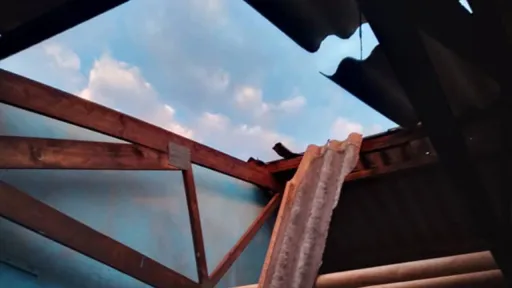
September 17 was meant to be just another weekend for Joy Ukadike as she stepped out of her home in the Ojo area of southwest Nigeria's Lagos with her sister for Sunday church service. It had rained heavily the night before, but she had no inkling of the near-apocalyptic scene that awaited her just beyond the gate to her apartment building.
Joy froze in her tracks at the sight of inundated residences and shops as far as her eyes could travel. People in the neighbourhood waded in and out of homes invaded by waist-deep brown, muddy floodwaters that seemed to have flowed in overnight.
Some apartment blocks – including Joy's – had escaped the deluge because the street slopes down from where these buildings stand.
That weekend, #lagosfloods trended on social media, with flood victims posting horrifying videos, one of which showed commuters screaming as they climbed out through the windows and doors of a bus that was quickly going down under on a submerged street.
Joy is relieved that her home wasn't impacted, but she wonders why flooding has become a cycle that repeats every year. "Why do we not, as a people and government, learn from past experiences and take steps to avert them?" she wonders. These are questions coursing through many parts of Africa, where urban flooding is an annual scourge that causes a rip tide of torment and frustration.
Widespread menace
In October, a landslide and floods wrought death and destruction in Mbankolo district to the west of Yaoundé, the capital of Cameroon.
In Libya, two dams collapsed as Mediterranean storm Daniel struck the northeastern part of the country on September 11, sending 1 billion cubic feet of water into already inundated areas. A quarter of the eastern city of Derna was obliterated. Overall, around 20,000 people were feared dead in the disaster.
Last year, Chad's heaviest seasonal rainfall in over 30 years left parts of the capital, N'Djamena, navigable only by boat and forced thousands to flee their flooded homes, news agency Reuters reported.
Deadly floods and landslides also devastated South Africa in April 2022 following three days of pounding rain that forced the country to declare a national state of disaster. Hundreds died, and thousands of homes were destroyed.
Earlier this year, the African Development Bank loaned Benin in West Africa around US $176 million to improve urban service delivery and build resilience to flooding caused by climate change.
According to a 2022 BMC Public Health study titled "Epidemiology of floods in sub-Saharan Africa: A systematic review of health outcomes", floods have affected 2.3 billion people worldwide in the last 20 years and are associated with a wide range of adverse health outcomes.
Nigeria's scourge




The country’s National Emergency Management Agency (NEMA) announced last year that 600 people had died in floods in different states, with more than 200,000 homes wholly or partially damaged, directly impacting about 2 million people.
UNICEF reported that more than 2.5 million people in Nigeria needed humanitarian assistance, 60% of whom were children. The UN agency said this section of the population was at increased risk of waterborne diseases, drowning, and malnutrition as a result of the worst floods to hit Nigeria in a decade.
Dr Selegha Abrakasa, an environmental scientist at the University of Port Harcourt, a coastal city in flood hotspot southern Nigeria, says casualty figures remain disturbing because people still do not understand the science that leads to the formation of floods and how to prepare better for such events.
"The challenge is to ensure that there are efficient warning systems in place to alert people to rising floodwaters and, in the worst-case scenario, have a contingency plan to evacuate people from these areas," he explains to TRT Afrika.
In 2012, floods caused rivers to burst their banks and submerge vast lands in 30 of Nigeria's 36 states, killing over 400 people and displacing 1.3 million. The disaster also resulted in damage estimated at US $17 billion, according to NEMA.
Seven years later, 277,555 people were affected by floods, and 158 were killed. The following year, the number of those affected by floods rose to 2,353,647, besides 69 deaths.
Illegal structures
On October 18 this year, the authorities demolished over 20 buildings erected on drainage channels in the Lekki area of Lagos State to stem perennial flooding.
The state commissioner for environment, Tokunbo Wahab, told reporters that construction of the demolished buildings had just started in 2020 when notices were issued, pointing out that they would obstruct the drainage system. Residents ignored these notices and warnings.
Peter Kolawale, a civil engineer in Lagos, stresses that building codes across areas prone to flooding can no longer be treated with levity. “This is a crime and should not be tolerated by any government," he tells TRT Afrika.
Kolawale blames unscrupulous engineers trying to save on building costs in flood-prone areas for the laxity in compliance. "It's always a battle trying to convince them when they cite money. They don't realise that this is about saving lives," he says.
Although the recent floods didn't directly impact Joy's home, she can no longer deal with the psychological torment of uncertainty. "I plan to leave this area," she says.
Kolawale advises anyone searching for a home to be careful. ''If you must live in a flood-prone area, watch out for the signs," he says. "Begin your search in the rainy season to be sure what you are walking into."