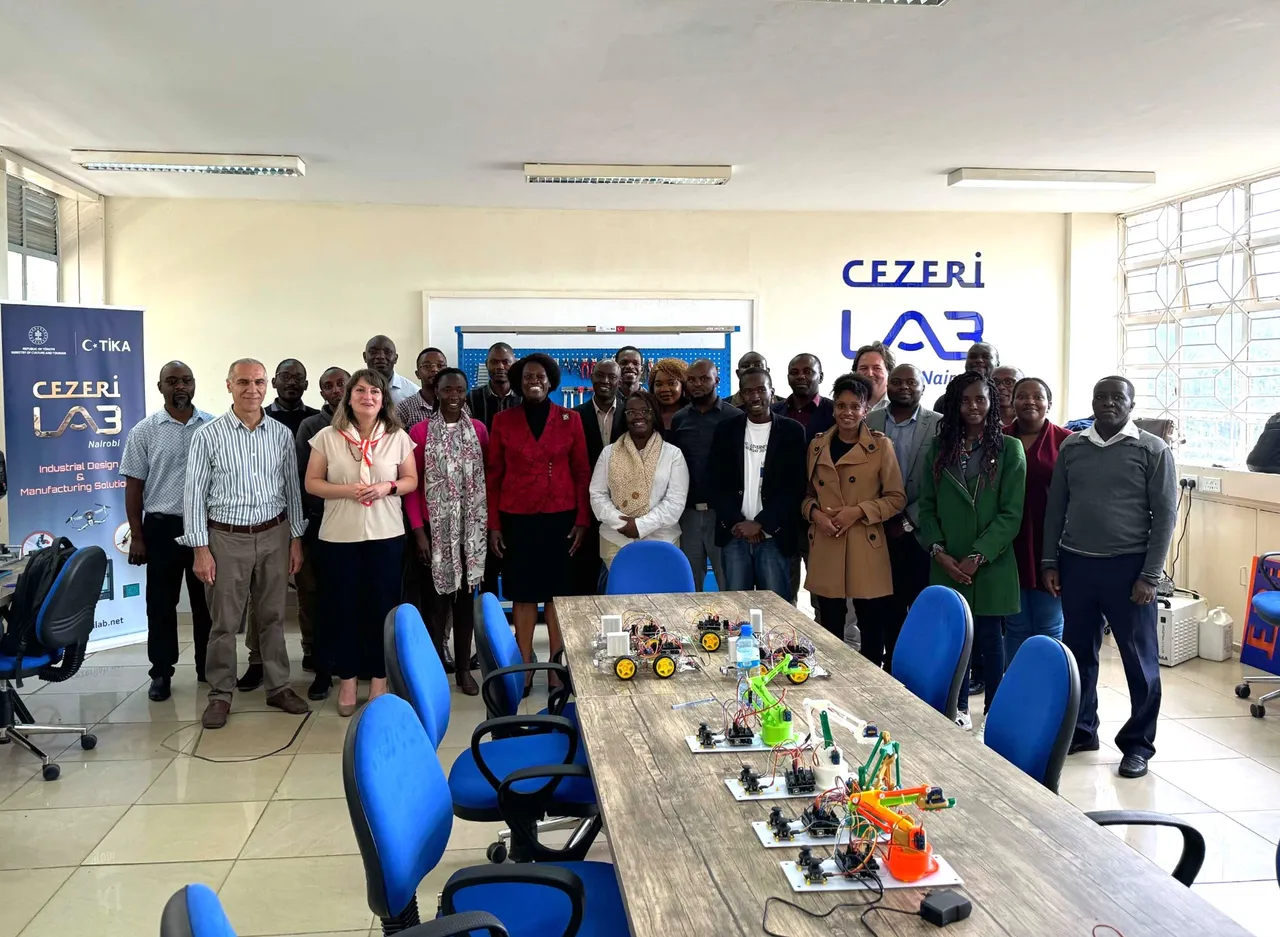
Inside a bustling workshop at a Kenyan university, a compact robot mounted on bright yellow wheels rolls across the tiled floor, pauses, turns its sensor-laden head, and recalibrates its route.
Nearby, students huddle over soldering irons and open circuit boards, carefully stripping wires, uploading new code, and testing prototypes that, just weeks earlier, existed only as rough sketches.
For many aspiring engineers, including students from families unable to afford such equipment, the Cezeri Lab represents the first place where abstract ideas take physical form.
Türkiye’s partnership with Kenya has introduced advanced fabrication tools that enable students to move beyond theory-heavy textbooks to building, handling, and watching machines come to life.
The Cezeri Lab is a technology and innovation initiative backed by the Turkish Cooperation and Coordination Agency (TIKA), aimed at fostering practical skills in robotics, coding, artificial intelligence, and applied engineering among young people.
Named after 12th-century inventor Al-Jazari, the programme emphasises hands-on learning using modern tools such as robotics kits, 3D printers, and coding platforms.
TIKA has rolled out Cezeri Labs across several countries to strengthen science, technology, engineering, and mathematics education. These labs have been established in countries including Somalia, Sudan, Ethiopia, Niger, and Tanzania, in collaboration with local universities and technical institutions. Beyond providing equipment, the programme also includes instructor training to ensure sustainability and local capacity building.
Robotics, automation, software development
In Kenya, the Cezeri Lab was launched at Jomo Kenyatta University of Agriculture and Technology (JKUAT), offering students practical exposure to robotics, automation, and software development to complement their academic coursework.
Fifth-year aerospace engineering student Brian Viiya stands beside a table cluttered with 3D-printed gears, servo motors, and hand-cut frames.
“The things we’ve been able to do in the short time that it has been here are incredible,” he said, noting that projects which once required months can now be completed “within a very short period of time and efficiently.”
More than speed, he said, the experience has instilled confidence among students who previously felt far removed from the global engineering community.
Close by, final-year student Alex Katuso carefully checks the alignment of a 3D-printed helicopter rotor, slowly rotating the blade between his fingers.
Inspired by childhood trips to the airport, where he watched planes take off and imagined how they worked, aviation has long been his ambition. Yet, until the lab was established, that goal felt out of reach.
“When I joined Kenyatta University, being the only university offering aerospace engineering up to now, I’ve seen it fulfilling my dreams and making me see that, yes, there’s a future and there’s hope,” Katuso said.
A space that feels alive
The lab itself feels like a living organism. Filament 3D printers hum steadily in one corner, laying down thin layers of melted plastic that gradually rise into green and yellow robot parts.








Resin printers in the next row shine UV light across smooth surfaces, exposing intricate biomedical models like a detailed human brain, now used for anatomy training.
Laser cutters release thin curls of smoke as they carve precise gears and structural components. Students move fluidly between stations, driven by a mix of curiosity and urgency, racing to capture ideas before they fade.
At one bench, students demonstrate a collision-avoidance robot built entirely within the lab. As it nears a wall, an ultrasonic sensor detects the obstacle, stopping the vehicle instantly.
Another mode allows the robot to follow a continuous track, with infrared sensors automatically adjusting its movement. A third enables control via a mobile phone. Every part – from the chassis and wiring to the embedded code – was designed, produced, and assembled by the students in the facility.
According to Dr Ken Iloka, a lecturer in the Electrical and Electronics Engineering Department, the partnership has delivered far more than equipment.
It has fundamentally reshaped engineering education, he said, noting that Kenyan training has traditionally been heavily theory-based, with few opportunities for hands-on experimentation.
“Through this platform, the students will have the capacity whereby they go through the theoretical understanding of the programmes, they go to practical, and they are able to design, innovate first of all, then come up with designs and be able to prototype those designs,” he said.
Holding up one of the student-built vehicles, Iloka points out its sensors, wiring, and programmed responses, explaining how it detects obstacles, stays on track, and responds to remote commands.
“We now have the tools, the knowledge, the expertise,” he said, “We’ll really work hard to ensure that this is translated into the kind of education that Kenyatta University is known for.”
Where disciplines converge
At another table, Wairimu Maina from the Department of Architecture examines a complex 3D-printed model for a research facility. Its flowing curves and layered structure would have taken days to construct by hand.
“It’s easier when the student has an opportunity to print the form, as opposed to making it physically with paper and cardboard,” Maina said.
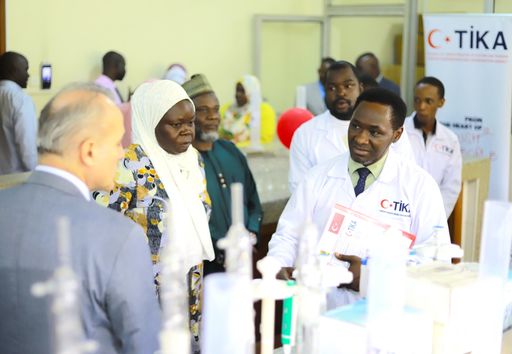
She added that access to newer printers enables students to better visualise their designs and test ideas that might otherwise remain abstract. The integration of sensors and coding, she noted, will also allow architecture students to explore smart building concepts, including climate-responsive systems that regulate humidity, lighting, and temperature.
Elsewhere in the lab, biomedical students study 3D-printed organs, mechanical engineers fine-tune moving components, and electrical engineering students assist peers with coding and circuitry. Civil engineering students, meanwhile, adapt fabrication tools to model infrastructure concepts.
For students who grew up without phones or computers — let alone advanced fabrication tools — the Cezeri Lab, now fully integrated into the university and run by students themselves, has become a vital link between imagination and opportunity.
Here, amid the hum of machines, scattered wires, blinking sensors, and constant collaboration, Kenya’s next generation of engineers is learning not just theory, but craftsmanship the skill of building solutions with their own hands.