 Esther Mpagalile
Over the past 10 years, the state of Africa’s social protection — “a set of policies and programmes aimed at preventing or protecting all people against poverty, vulnerability, and social exclusion throughout their life cycles — has been growing both in coverage and depth.
With governments increasingly adopting a range of social protection programmes such as cash transfers, health insurance, public works and more, this growth is geared towards the alleviation of poverty for vulnerable populations including children, women and persons with disabilities (UNDP, 2019).
Despite the formidable effort, compounding challenges such as climate change, limited fiscal space, political insecurity and weak institutions continue to threaten progress, undermining the effectiveness of well-intentioned social protection programmes and policies.
Today, Africa still lags in social protection coverage compared to the rest of the world, leaving its population precarious and susceptible to socioeconomic shocks. In fact, only 19.1% of the continent’s population is covered by at least one social protection benefit (ILO, 2024).
Against this background, this article argues that it is time the continent pursued mechanisms already set in the roots of its rich culture of Ubuntu: community-based social protection.
Bottom-up approaches to social protection
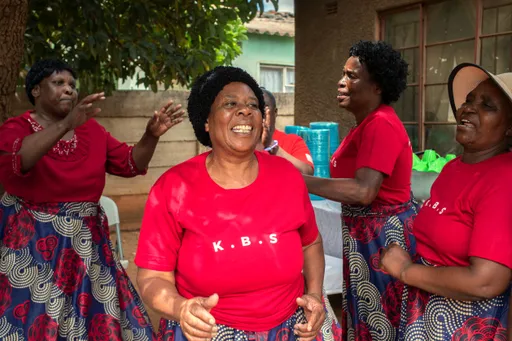
Community-based social protection organisations (CBSPOs) are locally rooted initiatives/community institutions made up of informal networks for the provision of socioeconomic support to vulnerable groups.
They are often made up of 10-40 members and have long become a lifeline for many communities, especially where formal social protection systems are weak and ineffective.
When compared side by side, CBSPOs and state-led social protection systems are similar in their role of providing safety nets and income stabilisation; however, they differ in their scope and nature of service, governance and accountability measures.

Late 2025, the African Union Commission and United Nations Development Programme launched From the Ground Up: Community-based Social Protection in Africa, a regional examining CBSPOs across five countries, 24 communities and 2,400 households.
The findings offer valuable lessons for shaping the future trajectory of social protection on the continent.
What do CBSPOs offer communities?
CBSPO members receive social, financial and sometimes emotional empowerment, necessary agency for the overcoming of cultural challenges. For youth, CBSPOs are a future safety net. As the report highlights, youth membership often begins upon attainment of household headship or marriage.
For women, CBSPOs are a source of empowerment, accelerating social safety nets in health, finance and livelihoods. Indeed, CBSPO membership is predominantly female - ranging from 58-64% - reflecting cultural gender roles within communities (Patino, Mpagalile and Kapingidza, 2025).
Who participates in CBSPOs?
The AUC-UNDP report conducted mixed methods research across surveyed countries of Ghana, Liberia-Sierra Leone borderlands, Rwanda and Zimbabwe. The qualitative method involved key informant interviews, focus group discussions and life histories.





Resulting transcripts revealed that access to financial resources at minimal to no interest is the primary reason for joining CBSPOs. Put off by high interest bank loans, which often require collateral, community members flock to CBSPOs such as ROSCAs, ASCAs and VSLAs, which offer low-cost loans and easier accessibility.
Where do CBSPOs fall short?
CBSPOs lack scale, financial sustainability and most importantly, inclusivity. The latter is an issue because due to the entry fee required to join an organisation, once again highlighting financial barriers that exist in local communities.
Additionally, although CBSPOs are excellent absorbers of idiosyncratic shocks such as illness and job loss, they do not do well with covariate shocks such as climate disasters and economic crises. Reflecting on their strength and weakness offers a great opportunity: the convergence of CBSPOs and state which will be discussed in the last section of this article.
How are CBSPOs governed?
CBSPOs are well governed institutions with structured leadership. In Liberia and Sierra Leone, 67% of surveyed CBSPOs directly elect their leaders, with women holding 63 percent of leadership positions in Sierra Leone.
Regarding formal registration, most CBSPOs view engagement with local authorities as an administrative formality rather than a substantive partnership. As a result, registration rates vary widely, from full registration in Rwanda to just 45 percent in Liberia.
What does this call for? Transparency and trust
To meaningfully position CBSPOs as complements to formal social protection systems — and as drivers of resilience and poverty reduction — transparency and trust are essential. The following policy recommendations offer a pathway towards achieving these goals.
Expanding social protection coverage in Africa requires intentional policy innovation. Innovation that places the strengths of CBSPOs at its core, addressing vulnerability, building resilience and ultimately, reducing poverty in the continent. What would this look like?
Firstly, CBSPOs must be recognised as critical institutions to support local needs. With dialogue, policymakers then need to integrate these institutions into formal social protection programmes at all levels.
Secondly, existing social protection governance models need to be participatory. This requires flexibility, targeted measures informed by the “voices of the recipients”, ultimately building culturally appropriate, inclusive and sustainable systems.
Public-private partnership will then become critical in advancing the African Union’s Agenda 2063 and the Sustainable Development Goals particularly target 1.3.
Rwanda for example, shows a special case where traditional community mechanisms are built into state-led systems, driven by homegrown solutions such as Ubudehe and Umuganda. Today, these systems continue to be central to community development and maintaining cultural values and history.
The story of CBSPOs is far from complete and must continue to be documented, with deeper and more systematic data generation to fully understand and support their role in Africa’s social protection systems. But for now, this report calls for three things: state-community collaboration; policy innovation; integration of community mechanisms in national level policies and programmes.
The writer, Esther Mpagalile, is an independent development economist whose work focuses on inclusive growth analysis, poverty diagnostics, social protection, and macroeconomic policy research.
Disclaimer: The views expressed by the author do not necessarily reflect the opinions, viewpoints and editorial policies of TRT Afrika.