 Pauline Odhiambo
Lovemore Nyika took one look at the cooler full of black soldier fly larvae and told the trainers they had lost their minds.
"You want me to feed maggots to my fish?" he asked.
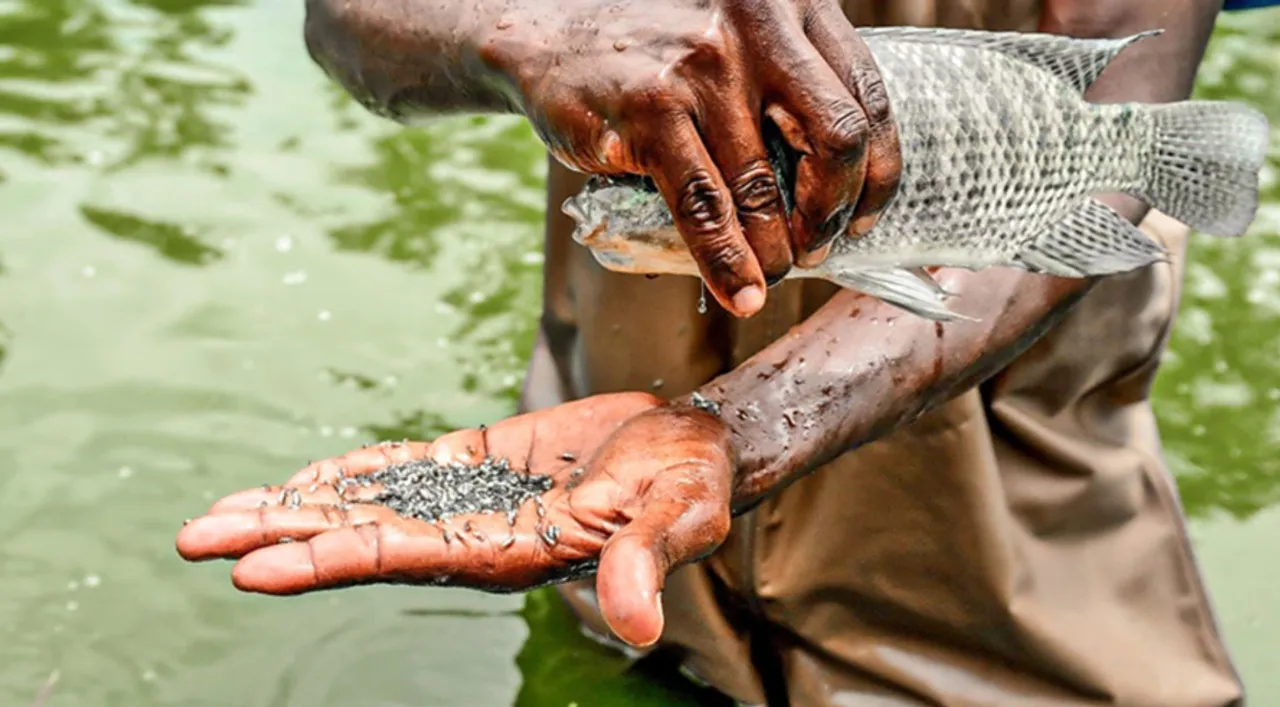
For 15 years, the 58-year-old fish farmer from Manicaland in eastern Zimbabwe had watched imported feed swallow 70% of his costs. His ponds yielded enough tilapia to survive on, albeit never enough to expand the business.
An even bigger regret for Nyika was not being able to afford sending his youngest daughter to teachers' college.
Then came FISH4ACP, the Food and Agriculture Organisation (FAO)-led initiative funded by the European Union and Germany, with a proposition that sounded bizarre – replace expensive commercial feed with high-protein insect larvae reared on vegetable waste to cut costs by 40%.
Eighteen months later, Nyika's ponds produce 40% more tilapia than before. His daughter Tariro starts her teaching diploma next month. And the "maggot farm" where black soldier flies convert neighbours' vegetable scraps into feed has become a small enterprise of its own.
"We were sitting on gold," Nyika tells TRT Afrika. "We just didn't know what it looked like."
Claiming space
Tanaka Moyo, 24, inherited her grandfather's fish farm but not his standing. Local restaurants that had bought from "Old Man Moyo" for decades found reasons not to buy from his granddaughter. At farmers' meetings, men directed their remarks to the empty chair beside her.
"I knew how to raise fish," she says. "The challenge was getting people to see me as a farmer, not a girl playing in the mud."
When FISH4ACP assessed Zimbabwe's tilapia value chain, women and youth participation stood at roughly 10%. It was a figure that reflected exclusion, not capability.
Tanaka came close to selling her ponds and buying a bus ticket to South Africa.
What changed her mind – and what is gradually reshaping the sector – is an approach that treats aquaculture as a system rather than a collection of individual farms.

Zimbabwe has abundant water sources and the ideal climate for rearing tilapia, yet the industry was barely noticed in the country's economy.
Farmers worked in isolation, hatcheries produced inconsistent fry, and government policy for the sector dated back to an era when the country had only a handful of organised fish farms.
Insect economics








Black soldier fly larvae pack more protein than soy, thrive on waste and produce nutrient-rich fertiliser as a byproduct.
But the real shift is in the business model. Rather than training every farmer to rear larvae, FISH4ACP established specialised insect enterprises — new economic niches for women and youth who might not own pond land but could supply the growing value chain from the edges.
In Manicaland, more than 350 farmers have received training in both aquaculture and what the programme calls "inclusivity and assertiveness". These are the practical skills of claiming space in markets that have historically shut them out. The target is to raise women and youth participation from 10% to 40%.
For Tanaka, the training opportunity arrived at the right moment. "They taught me how to speak in meetings," she says. "I learnt to bargain for fair prices when buyers assume I would accept anything because I am young and female."
Tanaka now supplies tilapia to three restaurants in Mutare. She has hired two young women from her village and rears black soldier fly larvae to sell to neighbouring farms.
"I tell young people that you can't eat your grandfather's reputation. But you can build your own," she tells TRT Afrika.
Legislative anchor
After decades without dedicated fisheries legislation, Zimbabwe is preparing its first Fisheries and Aquaculture Bill, a framework officials describe as a potential game-changer. The objective is to build a US $1 billion fish economy by 2032, producing 14,000 tonnes of tilapia annually.
The bill frames aquaculture within a vision for what the government calls a "resilient and inclusive blue economy".

For the FAO, this policy alignment matters more than immediate outcomes. "Technology alone doesn't transform systems," says Patrice Talla, FAO's subregional coordinator. "It must be accompanied by institutions capable of scaling and sustaining innovation."
As FISH4ACP widens the net, its focus shifts from proof-of-concept to scale. But challenges remain. Insect production needs regulatory approvals still in draft, farmers require consistent fry quality and processing capacity, and women and youth still face social barriers that training alone cannot dismantle.
Nyika no longer measures success solely by his own output. He measures it in the neighbouring farmers installing insect bins after watching his feed costs drop, and in his daughter's plan to run fish-farming demonstrations at the school where she will teach.
"When I started, fish farming was what you did because you couldn't do anything else," he says. "Now, young people call me to ask how to begin."
Tanaka is happy to further her grandfather's legacy on her terms. "He had to wait for others to bring feed and to buy his harvest," she tells TRT Afrika. "Now, we control the inputs. We control production. We are building markets ourselves. This isn't just fish farming; it's an industry."