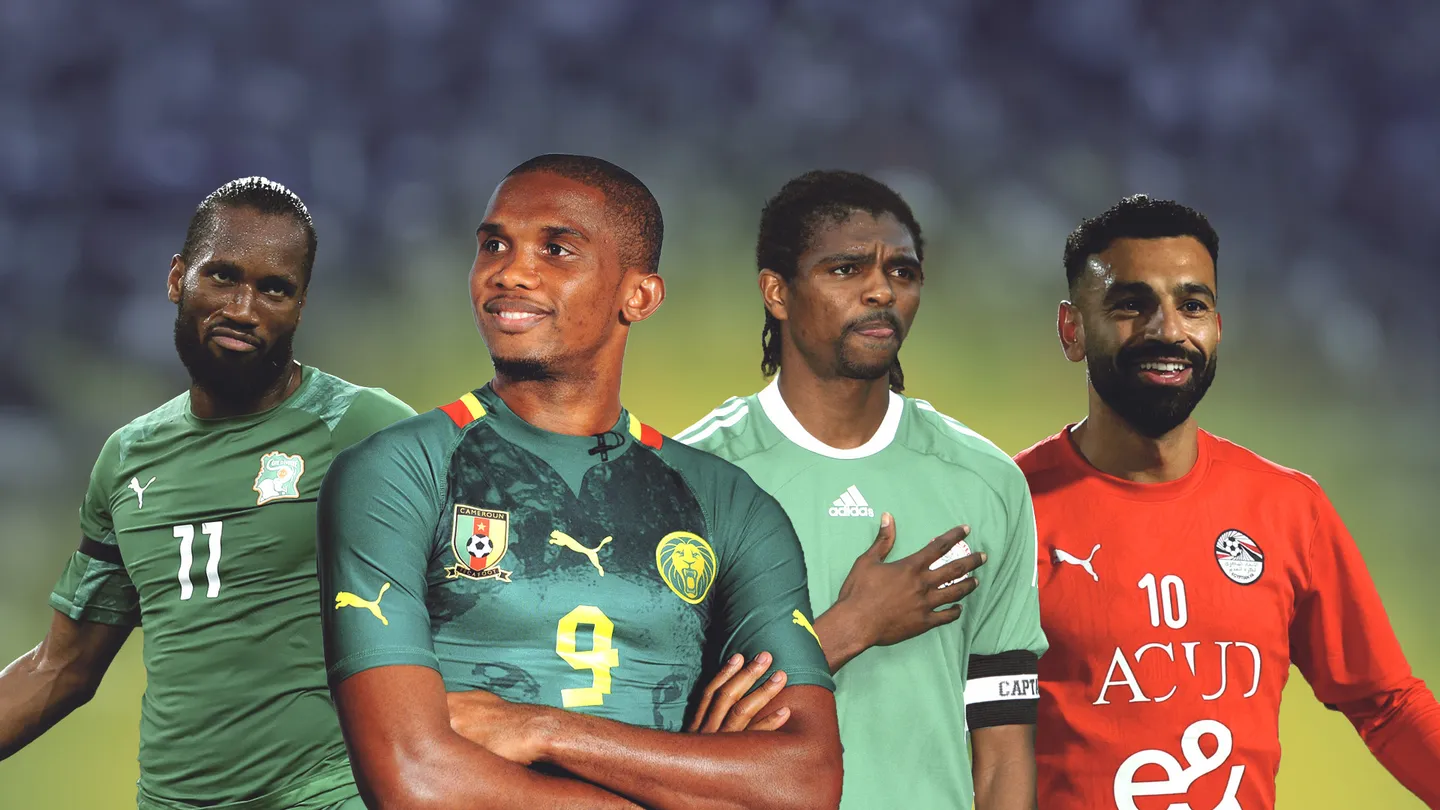
From the open fields of Accra and Bamako to the floodlights of Paris and London, African footballers have rewritten the story of the beautiful game.
They have carried a continent’s pride, inspired peace, and shattered barriers — proving that football is more than a sport; it’s a voice, a movement, and sometimes, a revolution.
With the 2025 Africa Cup of Nations (Afcon) fast approaching, let’s look at some African footballers whose influence changed global sports — and whose legacies continue to inspire.
1. George Weah (Liberia) – The president who first conquered football
Before he became Liberia’s president, George Weah ruled the world of football. The first and only African to win the Ballon d’Or and FIFA World Player of the Year, Weah’s rise from the slums of Monrovia to AC Milan’s San Siro remains one of sport’s most powerful stories.
But it wasn’t only his goals that mattered — it was his journey. Weah’s life showed millions of Africans that dreams born in poverty could reach the global stage, and that leadership could begin with a ball at one’s feet.
2. Didier Drogba (Côte d’Ivoire) – The striker who stopped a war
Few players have ever bridged sport and politics like Didier Drogba. His goals at Chelsea brought trophies, but his voice brought peace. In 2005, Drogba used his platform to urge warring factions in Côte d’Ivoire to lay down their arms — and they listened.
On the pitch, he was the ultimate big-game player: fierce, unyielding, and brilliant. Off it, he became a symbol of unity, proving that football can be more than a game — it can be diplomacy.
3. Samuel Eto’o (Cameroon) – Africa’s serial winner
If trophies define greatness, Samuel Eto’o stands unmatched. With three UEFA Champions League titles, four African Player of the Year awards, and over 350 career goals, he is Africa’s most decorated footballer.
At Barcelona and Inter Milan, Eto’o’s instinct, power, and precision made him unstoppable.
Yet his legacy extends beyond the accolades — it’s in his relentless commitment to raising Africa’s footballing standards, both on the field and now as Cameroon’s federation president.
4. Mohamed Salah (Egypt) – The modern pharaoh
In an era of super-clubs and superstars, Mohamed Salah stands out for his humility as much as his brilliance. From rural Egypt to Liverpool’s Anfield, Salah’s story is one of perseverance and purpose.
A two-time Premier League Golden Boot winner and Champions League champion, Salah redefined what global fandom means. His faith, discipline, and philanthropy — funding schools and hospitals in Egypt — have turned him into more than a footballer; he’s a national role model.
5. Yaya Touré (Côte d’Ivoire) – The engine of a new era
Commanding, creative, and calm — Yaya Touré changed what it meant to be a midfielder.
At Manchester City, he was the heartbeat of the team that transformed English football. His goals, especially in decisive moments, carried both elegance and power.
Four-time African Player of the Year, Touré’s influence extended to young players across Africa, proving that leadership and artistry can coexist on the same field.



6. Roger Milla (Cameroon) – The dance that shook the world
When Roger Milla danced beside the corner flag at the 1990 World Cup, it wasn’t just celebration — it was liberation.
At 38, Milla led Cameroon to the quarterfinals, becoming the face of African joy, rhythm, and resilience.
His performances changed global attitudes toward African football, inspiring generations who saw, perhaps for the first time, that Africa belonged on football’s biggest stage.
7. Jay-Jay Okocha (Nigeria) – The artist with the ball
Football has its poets — and Jay-Jay Okocha was one of them. Every touch, every flick, every dribble told a story of imagination and joy.
His creativity inspired not only fans but future greats like Ronaldinho, who learned under Okocha at Paris Saint-Germain.
He may not have won as many titles as others on this list, but Okocha’s influence is immortal. He reminded the world that football is, above all, an art.
8. Nwankwo Kanu (Nigeria) – The heart of a champion
Nwankwo Kanu’s story is one of survival and service. After winning the Champions League and Olympic gold, he faced a life-threatening heart defect.
Instead of giving up, he turned his battle into a mission — founding the Kanu Heart Foundation, which has saved thousands of lives across Africa.
Kanu’s quiet grace and perseverance transformed him from an athlete into a humanitarian hero.
9. Sadio Mané (Senegal) – The humble superstar
Few players embody humility like Sadio Mané. From a small village in Bambali to the pinnacle of world football, Mané’s rise has inspired millions.
A Champions League and Afcon 2022 winner, Mané invests heavily in his hometown — building hospitals, schools, and mosques.
In an age of fame, he remains grounded, showing that true greatness is measured by what one gives back.
10. Riyad Mahrez (Algeria) – The Maghreb’s miracle
When Riyad Mahrez helped Leicester City win the 2016 Premier League, the world witnessed a fairytale written by an Algerian winger with unmatched finesse.
His vision and technique earned him a move to Manchester City, where he lifted the Champions League and multiple domestic titles.
Mahrez proved that the Arab world, too, is an inseparable part of Africa’s football legacy — blending flair, discipline, and determination on the global stage.
Across continents and generations, these footballers carried Africa’s hopes — and changed football’s global narrative. Their stories reflect more than sporting triumph; they echo unity, resilience, and pride.
From Monrovia to Cairo, Dakar to Yaoundé, these icons remind us that football is not just played — it’s lived, and Africa continues to give it its soul.